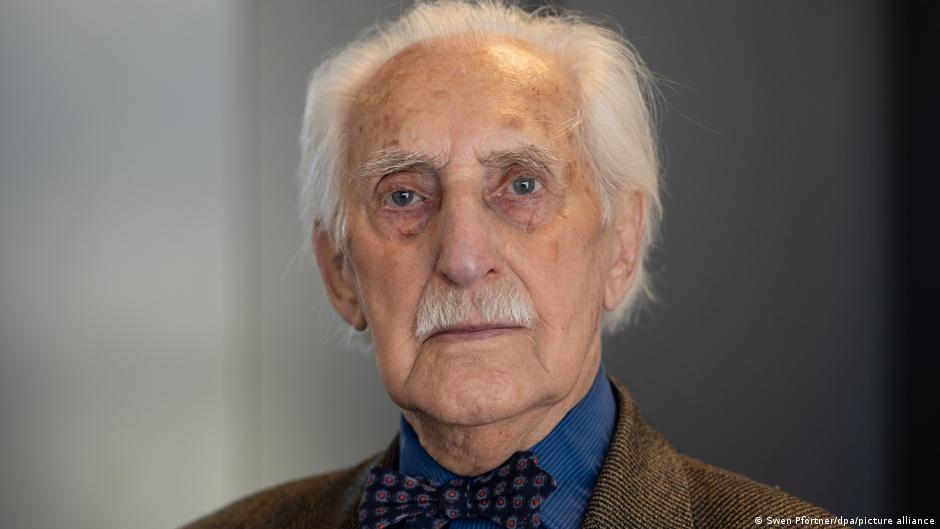
"There they came, seemingly endless rows of tall, healthy young soldiers in green Wehrmacht uniforms. The thought of the sound of their hobnail boots on the cobblestones still sends a cold shiver down my spine," he tells DW. "They exuded so much power and would smash anything that stood in their way." Weintraub was only 13 then and had no idea what horrors awaited him. He lived in a poor neighborhood with his four sisters and his mother, who ran a small laundry service."
"Many people in the ghetto died of disease and hunger. "So, the word hunger' has a very special place in my vocabulary, my mind, and my being," says Weintraub. Today, people often say they're hungry when they skip a meal, but "that's not true hunger, that's just increased appetite. "For five years, seven months, and three weeks, except for one occasion, I literally suffered from starvation. I couldn't fall asleep because of the painful pressure in my stomach"
Leon Weintraub witnessed the Nazi occupation of Lodz on September 9, 1939, as German soldiers marched into the town. At 13 he and his family were forced into the Lodz ghetto in February 1940, where 160,000 Jews were crammed and escape meant being shot. He performed hard labor in the metal department of an electrical workshop and learned from the Judenrat that usefulness might increase survival chances. Many ghetto residents died of disease and hunger; Weintraub experienced prolonged starvation for over five years, describing chronic pain and sleeplessness caused by the pressure in his stomach. He grew up in a poor household with four sisters and a mother who ran a laundry; his father died when he was two.
Read at www.dw.com
Unable to calculate read time
Collection
[
|
...
]