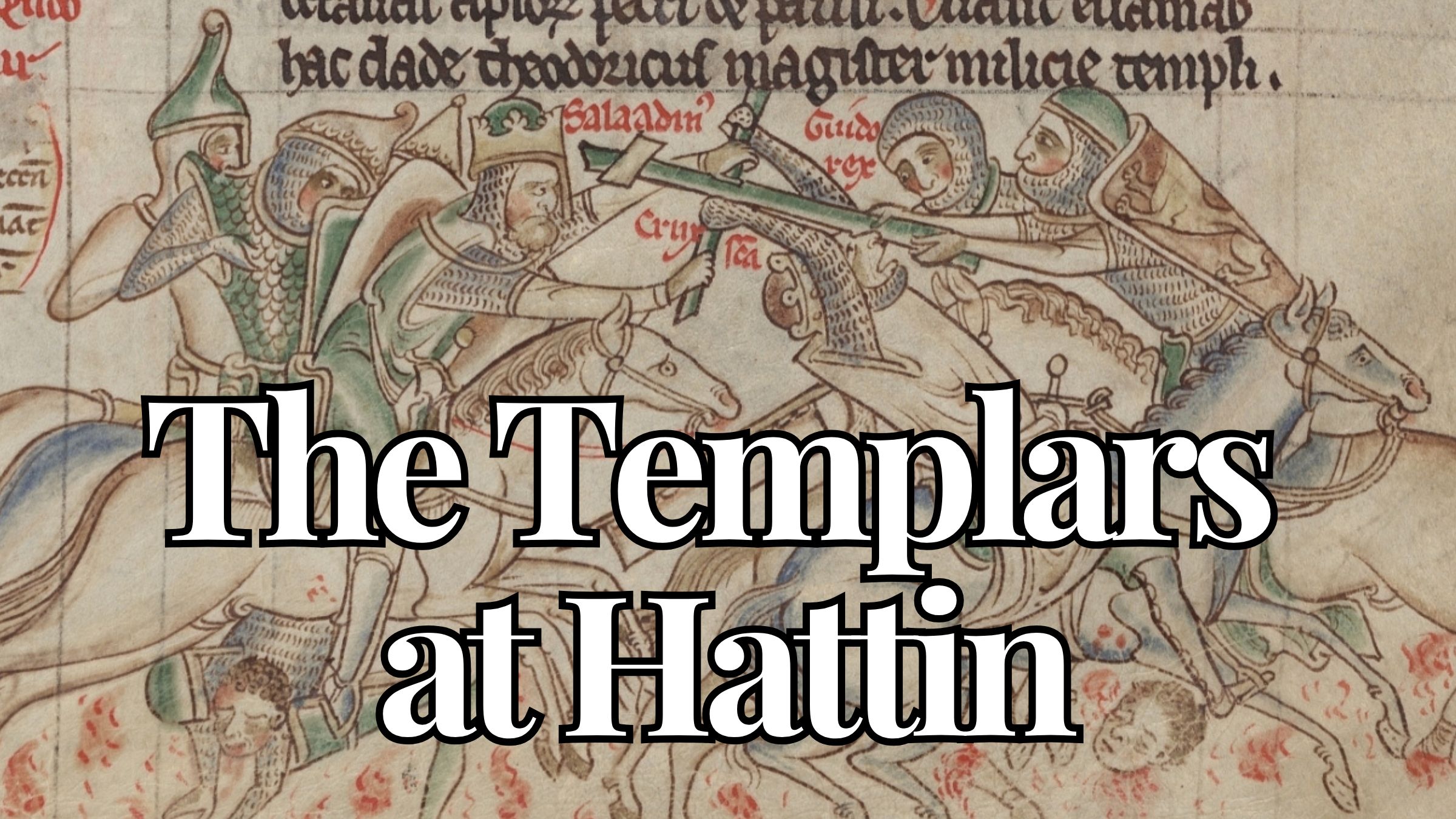
Guy of Lusignan led a Frankish army in July 1187 along an almost waterless route to relieve the besieged castle of Tiberias, despite being surrounded and outnumbered by Saladin's forces. The Templars were given the dangerous rearguard position and, under increasing pressure, were pushed back. They eventually made a desperate charge to hold the enemy at bay but received little to no support from other parts of the army. Messages after the battle blamed the lack of assistance for the failure of the Templar charge. The collapse left the king isolated and many knights lost or captured.
"At the centre of the collapse stood the Templars, whose final charges became one of the most desperate last stands of the Crusades. In July 1187, shortly after the intangible glory (and all too tangible gore) of the Templar massacre at the Springs of the Cresson, Guy of Lusignan, the weak and vacillating king of Jerusalem, made an appalling decision he was persuaded to take his troops to the rescue of the castle of Tiberias, besieged by Saladin's armies."
"As the doomed crusader army paced slowly towards the village of Hattin on 34 July 1187, the Templars were assigned the position of greatest danger, and the one which the Franks knew required most discipline in the face of enemy provocation the rearguard. The Templar rearguard was increasingly pushed back, as the weight of enemy numbers began to tell. Eventually, they made a desperate charge to try to keep Saladin's troops at bay."
"Afterwards, as recriminations were bandied about, messages sent back to the West after the battle complained that it was only a lack of support from other parts of the army that had caused the Templar charge to fail. One letter sent by the Hospitallers to Italy said that at around the third hour the master of the Temple charged with all his brothers. They received no assistance, and God allowed most of them to be lost.'"
Read at www.medievalists.net
Unable to calculate read time
Collection
[
|
...
]