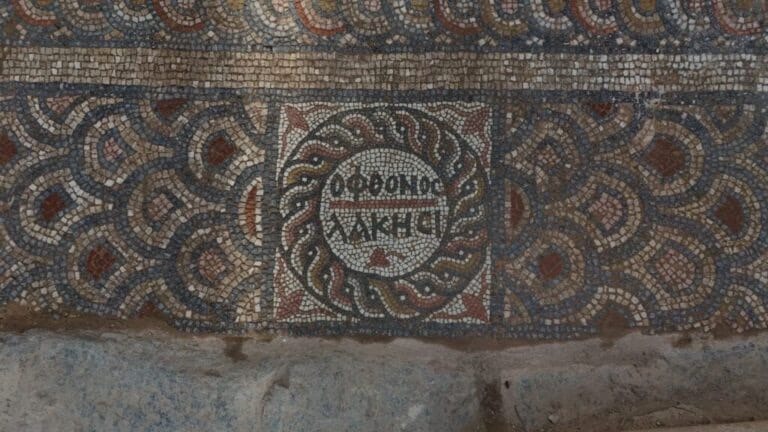
Archaeologists at the ancient city of Syedra in southern Turkey uncovered a remarkably preserved mosaic floor dating to approximately the 5th or 6th century AD. Measuring 4.5 by 4.5 metres, the mosaic displays intricate geometric and floral designs alongside two Greek inscriptions. The central inscription conveys a welcoming message meaning "Use it with joy" or "Enjoy it." The second inscription, positioned near the entrance, carries a playful sentiment translating to "May the envious burst with jealousy." Located in what appears to be an important residential building, the mosaic's entrance placement suggests visitors would encounter these messages first. Such inscriptions were common in late antique domestic mosaics, with homeowners using them to express pride, extend greetings, or ward off envy and misfortune.
"One inscription, placed at the centre of the mosaic, conveys a welcoming message-variously translated as "Use it with joy" or "Enjoy it." The second, located near the entrance within a circular border, carries a more playful and pointed sentiment: a phrase that can be understood as "May the envious burst with jealousy" or, as excavation director Ertuğ Ergürer explains, an expression "that corresponds to the phrase 'let the jealous one burst' that we still use today.""
"The mosaic was found in what archaeologists believe to be one of Syedra's important residential buildings. Its location at the entrance area suggests it would have been one of the first features seen by visitors, combining hospitality with a touch of wit-and perhaps a subtle warning to ill-intentioned guests."
"Such inscriptions were not uncommon in domestic mosaics of late antiquity. Homeowners sometimes used them to express pride, extend greetings, or ward off envy and misfortune. In this case, the pairing of a warm welcome with a cheeky jab at jealous onlookers provides a rare and personal insight into the attitudes and social behaviours of the building's inhabitants."
#byzantine-archaeology #roman-mosaics #ancient-inscriptions #late-antiquity-domestic-life #syedra-excavation
Read at Medievalists.net
Unable to calculate read time
Collection
[
|
...
]