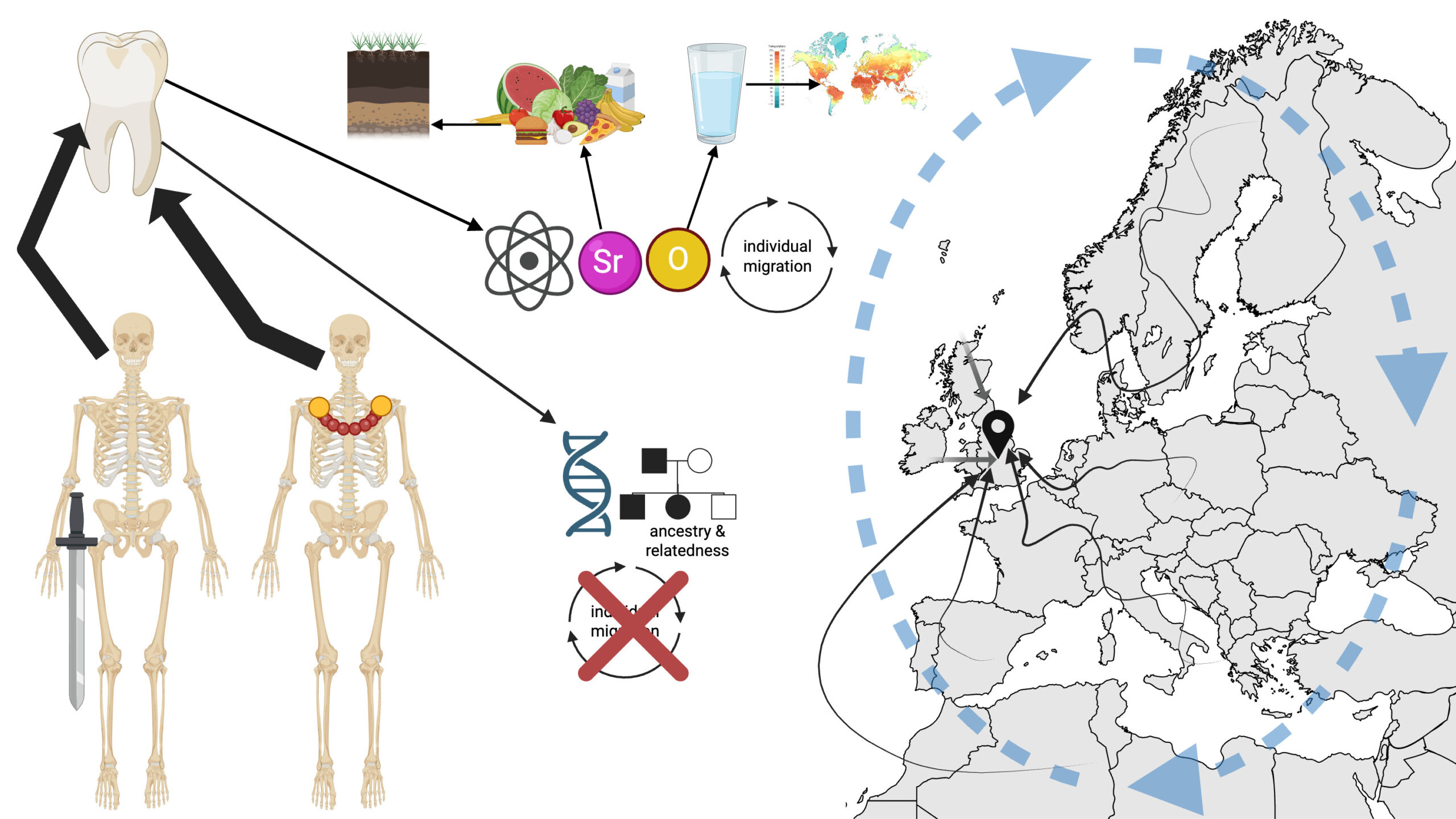
"A new large-scale study argues that movement remained a consistent feature of life between the end of Roman rule and the eve of the Norman Conquest, with tooth enamel chemistry and ancient DNA offering a clearer view of who was moving, when, and how patterns differed by sex and region. "The study took a 'big data' approach to assess the narratives around early medieval migration," explains Sam Leggett of the University of Edinburgh and one of the authors of the study."
"Looking at chemical clues locked into tooth enamel, the researchers identify 296 people whose childhood signatures do not match the area where they were buried-about 42% of the total sample. Most of that comes from oxygen measurements: 273 individuals stand out as likely to have grown up somewhere with noticeably different drinking water than the place they ended up. A smaller set shows unusual strontium values in their enamel, which can point to people raised on very different geology."
Migration remained a continual feature across early medieval England from the end of Roman rule to the eve of the Norman Conquest. Tooth-enamel oxygen and strontium isotopes and ancient DNA provide signals of childhood origin and ancestry. Isotope data from 700 measurements identify 296 individuals with childhood signatures differing from their burial locations—about 42% of the sample. Oxygen isotopes account for most non-locals (273 individuals); fewer show unusual strontium pointing to different geology. A few patterns align with later Scandinavian newcomers, and mobility varies by sex and region, reflecting sustained cross-cultural networks.
Read at Medievalists.net
Unable to calculate read time
Collection
[
|
...
]