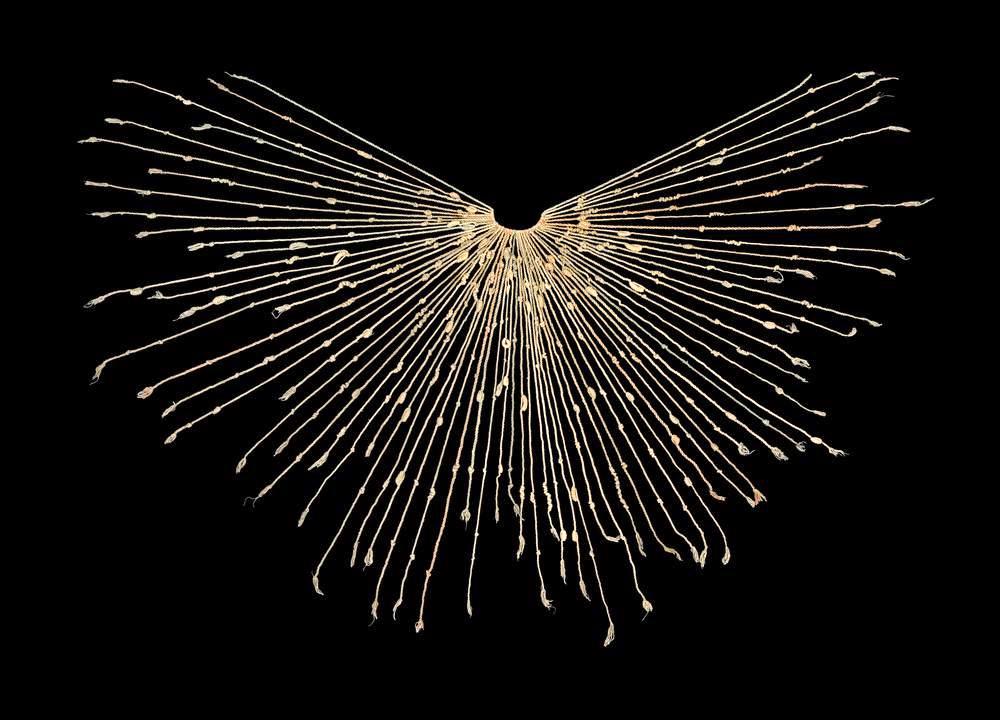
"the portable infor­ma­tion archives cre­at­ed by the Inca, may stir up mem­o­ries of 1970s macrame with their long strands of intri­cate­ly knot­ted, earth-toned fibers, but their func­tion more close­ly resem­bled that of a dense­ly plot­ted com­put­er­ized spread­sheet. As Cecil­ia Par­do-Grau, lead cura­tor of the British Museum's cur­rent exhi­bi­tion Peru: a jour­ney in time explains in the above Cura­tors Cor­ner episode, khi­pus were used to keep track of every­thing from inven­to­ries and cen­sus­es to his­tor­i­cal nar­ra­tives,"
"using a sys­tem that assigned mean­ing to the type and posi­tion of knot, spaces between knots, cord length, fiber col­or, etc. Much of the infor­ma­tion pre­served with­in khi­pus has yet to be deci­phered by mod­ern schol­ars, though the Open Khipu Repos­i­to­ry - com­pu­ta­tion­al anthro­pol­o­gist Jon Clin­daniel's open-source data­base - makes it pos­si­ble to com­pare the pat­terns of hun­dreds of khi­pus resid­ing in muse­um and uni­ver­si­ty col­lec­tions."
Inca khipus were portable information archives that recorded inventories, censuses, and historical narratives through a system of knot types, knot positions, spacing, cord length, and fiber color. Much of the information in surviving khipus remains undeciphered, but computational efforts like the Open Khipu Repository enable pattern comparison across hundreds of examples in museum and university collections. Interpretation was historically performed by trained quipucamayocs, high-born officials schooled in khipu creation and reading. Fleet messengers transported khipus between administrative centers, forming an information highway predating the Internet by centuries. Organic cotton and native camelid fibers provided durability suited to long-distance transmission.
Read at Open Culture
Unable to calculate read time
Collection
[
|
...
]