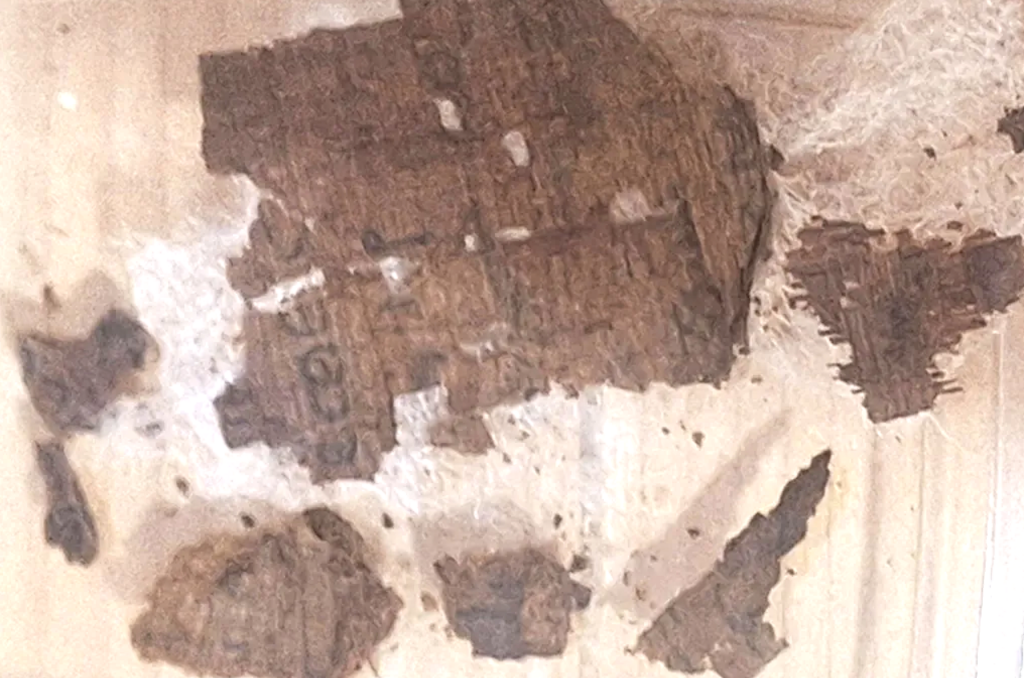
Renaissance Europe admired ancient Rome, ancient Rome admired ancient Greece, and ancient Greece admired ancient Egypt, with admiration flowing both directions where Greek and Egyptian periods overlapped. Greeks valued Egypt as a deep source of knowledge and wisdom, and Greek records preserve much of what is known about ancient Egypt. Archaeological evidence indicates Egyptians also valued Greek accomplishments. Hel lenic texts have been found in Egyptian burial sites, and a Greek literary work was recently discovered packaged with a mummy. The find includes pages from Homer’s Iliad unearthed from a 1,600-year-old Roman-era tomb in Al Bahnasa. The fragment contains lines from Book 2’s “catalogue of ships,” and the timing suggests Greek papyri may have functioned as a cultural passport. The Iliad pages may have been intended to help the deceased bypass underworld trials described in the Egyptian Book of the Dead.
"Unearthed from a 1,600-year-old Roman-era tomb in the Egyptian town of Al Bahnasa, the fragment contains lines from Book 2's epic "catalogue of ships," which lists all the vessels the Achaean army sends off to Troy. It dates from an era in ancient Egypt, centuries after the reign of the Greek-descended Cleopatra, when "Greek literary papyri may have functioned as a crucial cultural passport," as the New York Times' Franz Lidz writes."
"The Greeks made no secret of their regard for Egypt as a far deeper well of knowledge and wisdom (indeed, much of what we know about ancient Egypt today comes from Greek records), but archaeological evidence shows that the Egyptians, in turn, were hardly dismissive of Greek accomplishment. Many Hellenic texts have been discovered in Egyptian burial sites, but only recently has a Greek literary work turned up packaged with a mummy - and not just any literary work, but pages from Homer's Iliad."
""Being Hellenic connoted an exclusive social status and financial privilege - and had to be meticulously documented through genealogies going back several centuries." It's possible that pages of the Iliad were assumed to act as a kind of Greek passport that would let the deceased bypass the trials of the underworld described in the Egyptian Book of the Dead."
Read at Open Culture
Unable to calculate read time
Collection
[
|
...
]