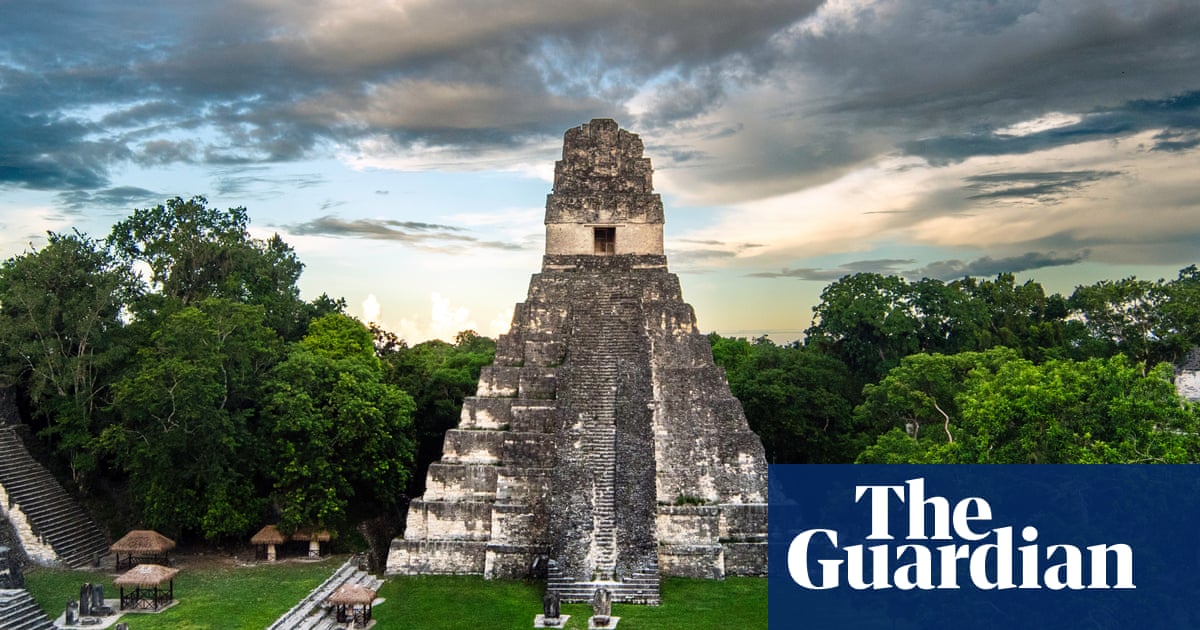
"Fifty-five years later, Estrada-Belli is now one of the archaeologists helping to rewrite the history of the Maya peoples who built Tikal. Thanks to technological advances, we are entering a new age of discovery in the field of ancient history. Improved DNA analysis, advances in plant and climate science, soil and isotope chemistry, linguistics and other techniques such as a laser mapping technology called Lidar, are overturning long-held beliefs. Nowhere is this more true than when it comes to Maya archaeology."
"When Estrada-Belli first came to Tikal as a child, the best estimate for the classic-era (AD600-900) population of the surrounding Maya lowlands encompassing present day southern Mexico, Belize and northern Guatemala would have been about 2 million people. Today, his team believes that the region was home to up to 16 million. That is more than five times the area's current population. This would mean that more people lived in the classic-era Maya lowlands than on the Italian peninsula during the peak of the Roman empire all crammed into an area a third of the size."
Francisco Estrada-Belli visited Tikal at age seven and later pursued archaeology focused on Maya civilization. Advances in DNA analysis, plant and climate science, soil and isotope chemistry, linguistics, and Lidar mapping enable major reassessments of ancient societies. Previous population estimates for the classic-era Maya lowlands centered around 2 million inhabitants; recent research raises that figure to as many as 16 million between AD 600–900. Such numbers imply far higher settlement densities, extensive agricultural systems, and complex urban and political organization, producing a societal scale comparable to ancient Rome concentrated within a much smaller geographic area.
Read at www.theguardian.com
Unable to calculate read time
Collection
[
|
...
]