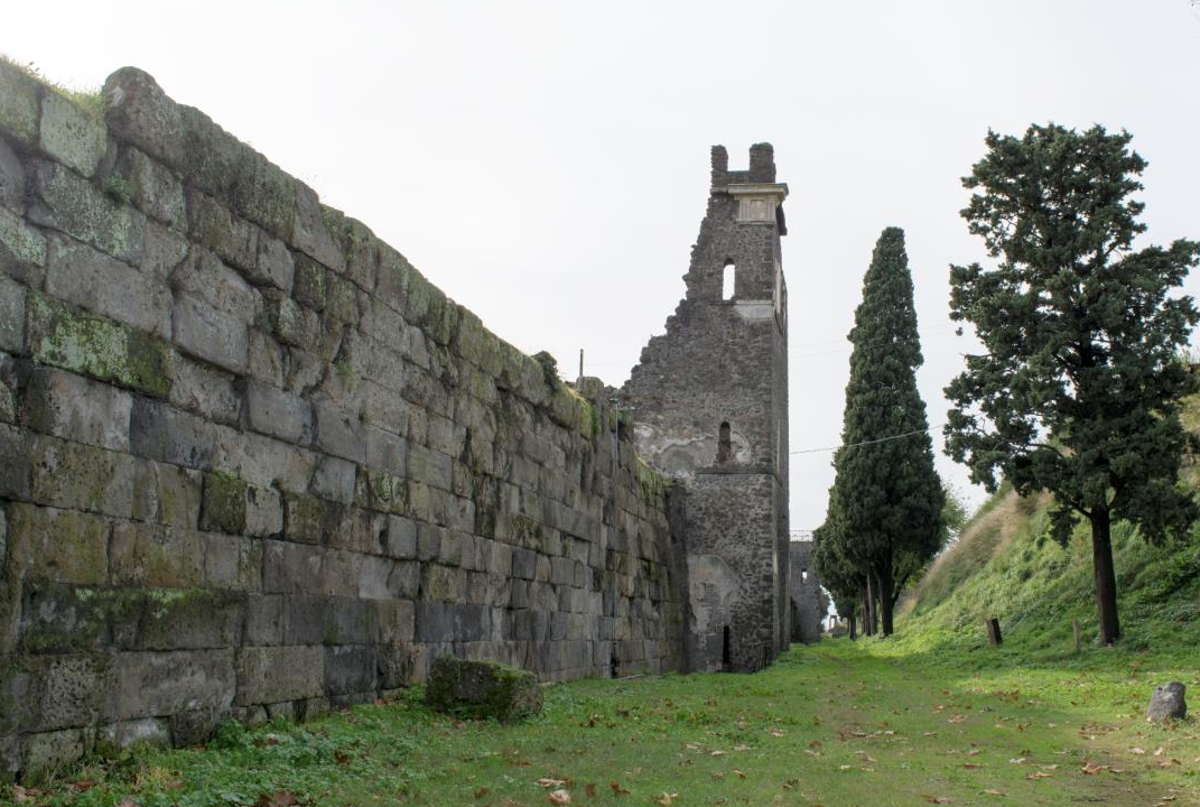
"The marks, which are sandwiched between towers once used to scout for armies and to allow archers and other artillery-throwers to fend off enemy incursions, are arrayed in a way that suggests they may have been left by a repeating dart-thrower called a polybolos."
"It was an antipersonnel weapon used to strike archers emerging from the battlements above and the postern below, says study lead author Adriana Rossi, an engineer at the University of Campania Luigi Vanvitelli in Italy."
"Philo of Byzantium, an ancient Greek engineer, was the first to describe the machine in the third century B.C.E. in his work Belopoeica, in which he critiqued it as impractical."
"It would be the kind of machine that was probably treated as either a novelty or proof of concept, says historian Michael Taylo."
In 89 B.C.E., Pompeii faced a siege led by Lucius Cornelius Sulla, resulting in the city's subjugation. Recent excavations revealed damage on the fortification walls, likely from this siege. Researchers found gouges that suggest the use of a polybolos, an ancient repeating dart-thrower. This weapon was designed to target archers and was described by Philo of Byzantium in the third century B.C.E. The polybolos had never been found in archaeological evidence before, indicating its historical significance and potential use in warfare.
Read at www.scientificamerican.com
Unable to calculate read time
Collection
[
|
...
]