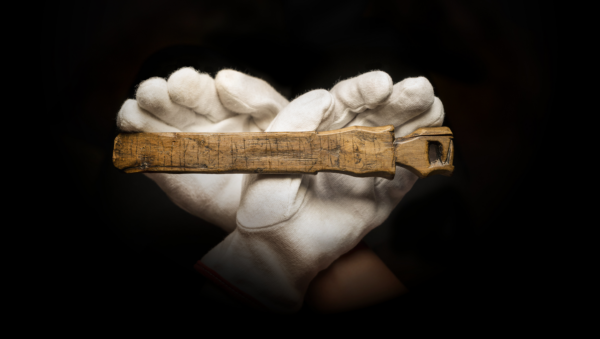
"How do you tell someone you love them in Viking-Age Sweden? You carve a message in runes on a knife: "Think of me, and I'll think of you." The Lödöse Museum in western Sweden is home to many of the over half-million archaeological finds from the region. Among them is an 11th-century skälkniven (paring knife), discovered during an excavation in 1973. Likely used in weaving, this wooden tool has a handle carved with a stylised animal head-its jaw set with powerful teeth."
"What really stands out, though, is the runic message carved into it. The Old Norse inscription reads: Mun Þu mik man Þik un Þu mer an ÞRr, which means "Think of me, I think of you, love me, I love you". Lödöse itself was one of medieval Sweden's earliest towns, a place shaped by trade and travel along the Göta älv river, exactly the kind of setting where small personal objects could pass from hand to hand."
"Marie Schmidt, an educator at the museum, explains: "It is not entirely clear how to interpret the inscription on the knife. Is this a fiancé's gift or perhaps a plea from a case of unrequited love? Perhaps it was used as a gift at a wedding? "We will never know the answer to that. But the message still echoes through history, like a loving whisper.""
The Lödöse Museum in western Sweden holds over half a million archaeological finds. An 11th-century skälkniven (paring knife) discovered in 1973 likely used in weaving has a wooden handle carved with a stylised animal head with powerful teeth. A runic Old Norse inscription on the knife reads Mun Þu mik man Þik un Þu mer an ÞRr, translated 'Think of me, I think of you, love me, I love you.' Lödöse was an early medieval Swedish town shaped by trade along the Göta älv river where personal objects could pass between hands. The Norse carved brief, personal runic messages on wood and bone. Similar intimate messages appear from Norway's Bryggen in Bergen, including almost identical runes expressing reciprocal affection.
Read at Medievalists.net
Unable to calculate read time
Collection
[
|
...
]