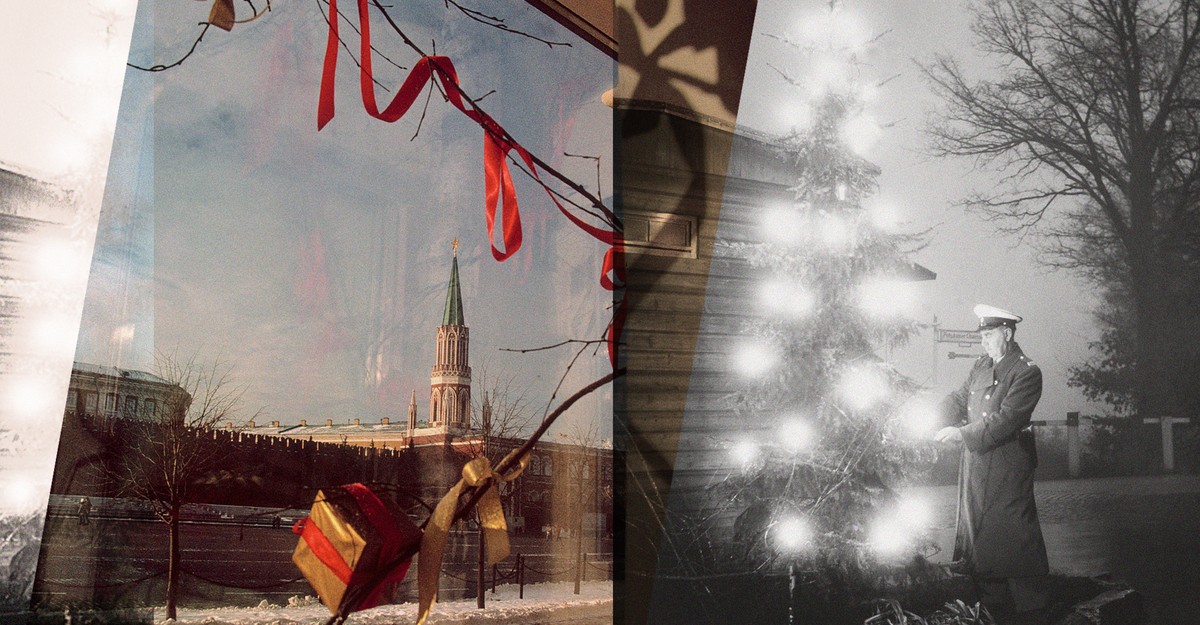
"Every year in late December, my childhood home transformed into a vision of American bliss. We'd gather to ornament a tree, drape string lights around the house, and sit down to an elaborate feast. Not long after dawn the next day, while our little sister still slept, my brother and I would impatiently sneak downstairs to see our gifts, which we understood to have been delivered by a kindly old man."
"Long before the 1917 revolution that brought them to power, the leaders of the Soviet Union had decried religion as, in Karl Marx's phrase, the opium of the masses. Their officially atheist government suppressed many kinds of spiritual observance, including Christmas. But by the mid-1930s, Soviet leaders sensed that people needed something to take the edge off in the dead of winter, a carnivalesque custom of the sort that Christmas once provided."
"It became arguably the most important holiday on the country's calendar. Other celebrations tended to come with historical significance, such as the anniversary of the revolution and of the Soviets' victory in World War II. But New Year's, at its core, was about nothing more and nothing less than family: a chance to come together and take stock. That may be a big reason it survived the Union's dissolution."
A suburban family recreated American-style Christmas rituals each late December while actually celebrating the Soviet version of New Year's. Soviet New Year's replicated many enjoyable elements of Christmas but deliberately excluded religious signifiers like Jesus or God. The holiday emerged after the suppression of religion, when mid-1930s leaders repurposed secular festivity to alleviate winter gloom, transplanting the most fun parts of Christmas onto New Year's. The celebration became a central, family-focused occasion on the Soviet calendar, distinct from historically themed state holidays. The family-centered nature helped the tradition persist in diaspora communities after the Soviet Union dissolved.
Read at The Atlantic
Unable to calculate read time
Collection
[
|
...
]