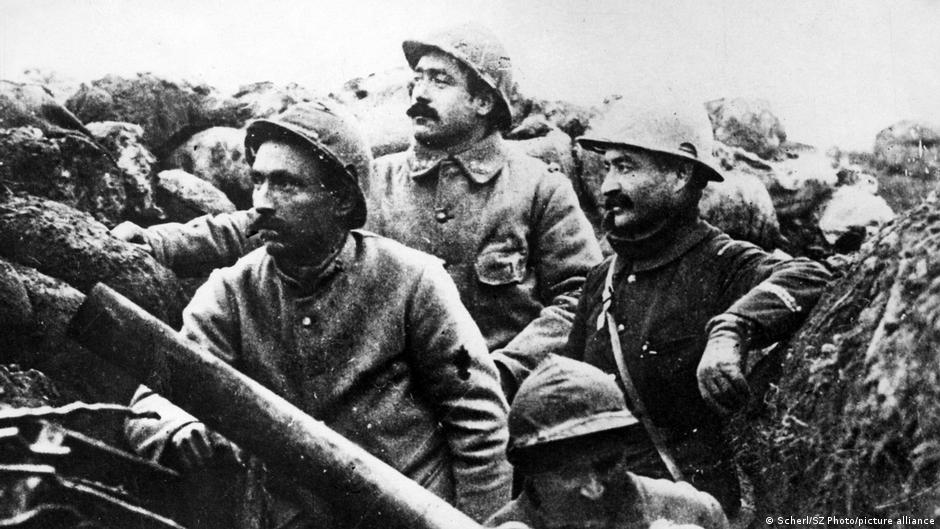
"It was still early in the morning when a rain of fire fell on the forts and trenches of Verdun. With 300 trainloads of ammunition, the Germans had been firing their artillery for hours on end. The thundering of cannons could be heard 150 kilometers (93 miles) away. The chief of the German General Staff, Erich von Falkenhayn, had given the order to attack the French."
"He wanted to end the trench warfare that had been raging along the Western Front between Belgium and France since September 1914, a few months after World War I broke out. His idea was to break through the front and return to mobile warfare, explains historian Olaf Jessen, author of "Verdun 1916: Urschlacht des Jahrhunderts" (or "Verdun 1916: Primordial Battle of the Century")."
"The French motto was "On ne passe pas" ("They won't get through here"). The battle went down in history as the epitome of senseless carnage. Amid grueling trench warfare, the men held out in their holes in the ground, with rats, lice, cold weather and bad food testing their nerves, along with the constant fear of death. The enemy often lurked just 30 meters (98 feet) away."
An intense German bombardment opened the Battle of Verdun, delivering 300 trainloads of ammunition and continuous artillery fire aimed at breaking the Western Front. The German plan sought to end static trench warfare and resume mobile operations, but miscalculation produced ten months of brutal, attritional fighting over every village and hill. French forces held firm under the motto "On ne passe pas," enduring rats, lice, cold, poor food and constant fear with the enemy often only 30 meters away. Artillery, heavy mortars, flamethrowers, machine guns, 26 million shells and 100,000 gas grenades devastated a battlefield under 30 square kilometers, leaving rotting corpses, exposed remains, mud and icy water.
Read at www.dw.com
Unable to calculate read time
Collection
[
|
...
]