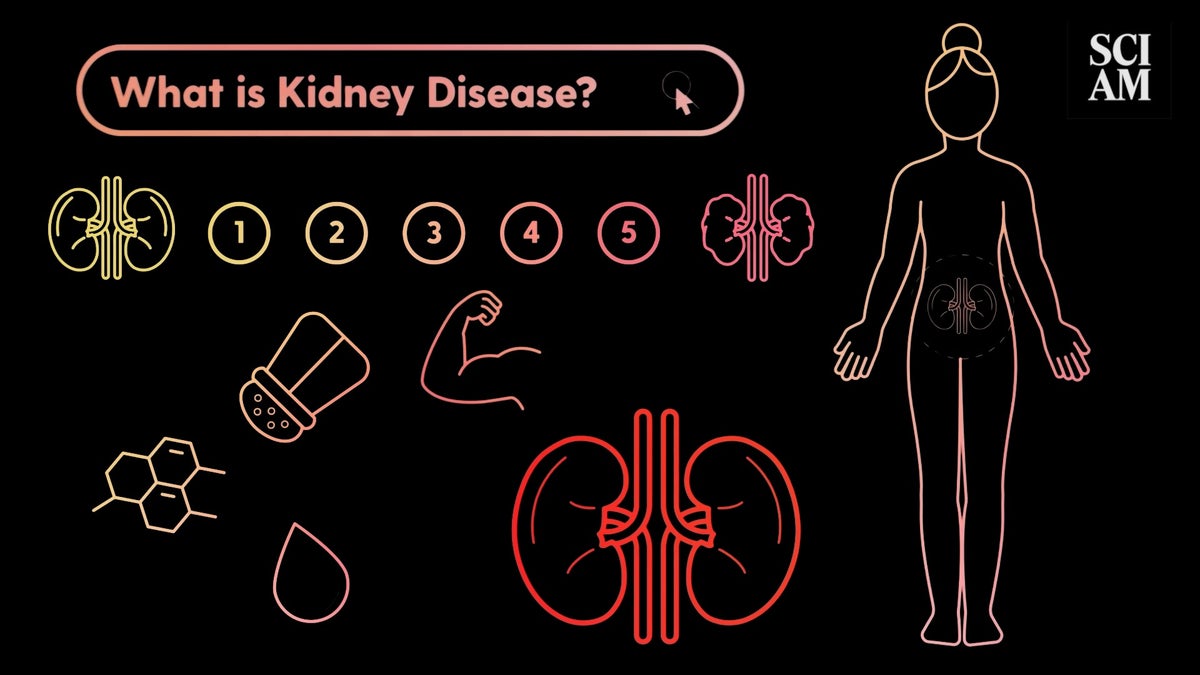
"Over the course of a day, our kidneys take in around 150 quarts of blood. If you had to drink that much fluid, you'd have to chug a gallon and a half every hour, 24 hours a day, for the rest of your life. Your kidneys do this automatically by passing your blood through millions of filtering units called nephrons."
"The glomerulus is made up of small blood vessels whose thin walls filter waste and water through while holding on to blood cells and larger molecules. The waste and water then goes into the tubule, where it runs next to a blood vessel holding the filtered blood from the glomerulus. This allows the tubule to return the nutrients and water we need back to our blood."
"Your kidneys do the impossible for you every day of your life—keeping you alive by constantly filtering your blood so that you can maintain the right balance of nutrients, salts and water that our cells all need to function."
Kidneys function as the body's filtration system, processing roughly 150 quarts of blood daily through specialized filtering units called nephrons. Each nephron contains two main components: the glomerulus, which filters waste and water through thin blood vessel walls while retaining blood cells and larger molecules, and the tubule, which runs alongside filtered blood vessels. The tubule reabsorbs necessary nutrients and water back into the bloodstream, while remaining waste becomes urine. This continuous filtration maintains critical balances of nutrients, salts, and water essential for cellular function. When kidney filters fail, waste accumulates in the body, similar to a broken pool filter, making the system unusable and threatening survival.
Read at www.scientificamerican.com
Unable to calculate read time
Collection
[
|
...
]