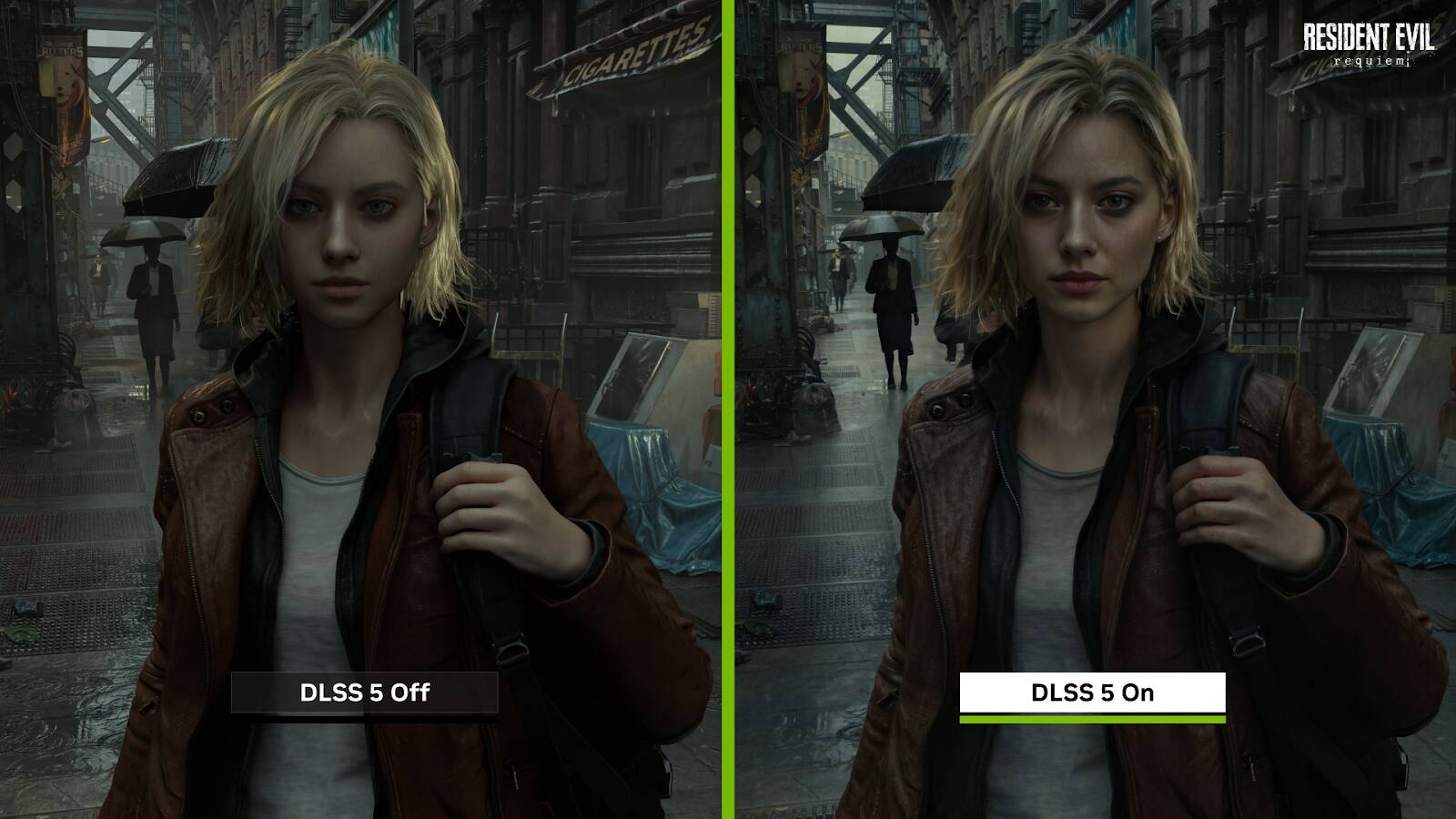
"Announced at Nvidia's GTC 2026 keynote and due out this fall, DLSS 5 takes an application's existing 3D content, colors, and motion and uses AI to add photorealistic lighting. The AI understands what typical human elements such as skin, hair, and clothing should look like. Then, even after viewing a single frame, it's able to adjust the lighting and colors to make them all the more real."
"Nvidia CEO Jensen Huang said on stage that the process DLSS 5 uses is called "neural rendering," because it "fuses" AI and 3D graphics. DLSS (Deep Learning Super Sampling) debuted in 2018 on RTX 20 series cards. It uses AI to squeeze more performance out of GeForce GPUs by upscaling natively lower resolution frames or inserting additional frames generated by AI instead of relying entirely on traditional rendering."
""About 10 years ago, we thought that AI would revolutionize computer graphics," Nvidia CEO Huang noted before he showed a demo video of DLSS 5. "Just as GeForce brought AI to the world, AI is now going to go back and revolutionize how computer graphics is done altogether.""
Nvidia announced DLSS 5 at GTC 2026, launching this fall. The technology uses AI neural rendering to fuse artificial intelligence with 3D graphics, adding photorealistic lighting to game characters. DLSS 5 analyzes existing 3D content, colors, and motion, then applies AI understanding of human elements like skin, hair, and clothing to enhance realism. The system adjusts lighting and colors after viewing a single frame to create more convincing results. DLSS, which debuted in 2018, traditionally uses AI to improve GPU performance through frame upscaling and generation. Nvidia CEO Jensen Huang emphasized that AI will revolutionize computer graphics, demonstrating the technology's dramatic transformation of character appearance in games like Resident Evil: Requiem.
#ai-graphics-rendering #dlss-5-technology #photorealistic-characters #neural-rendering #game-graphics-enhancement
Read at Theregister
Unable to calculate read time
Collection
[
|
...
]