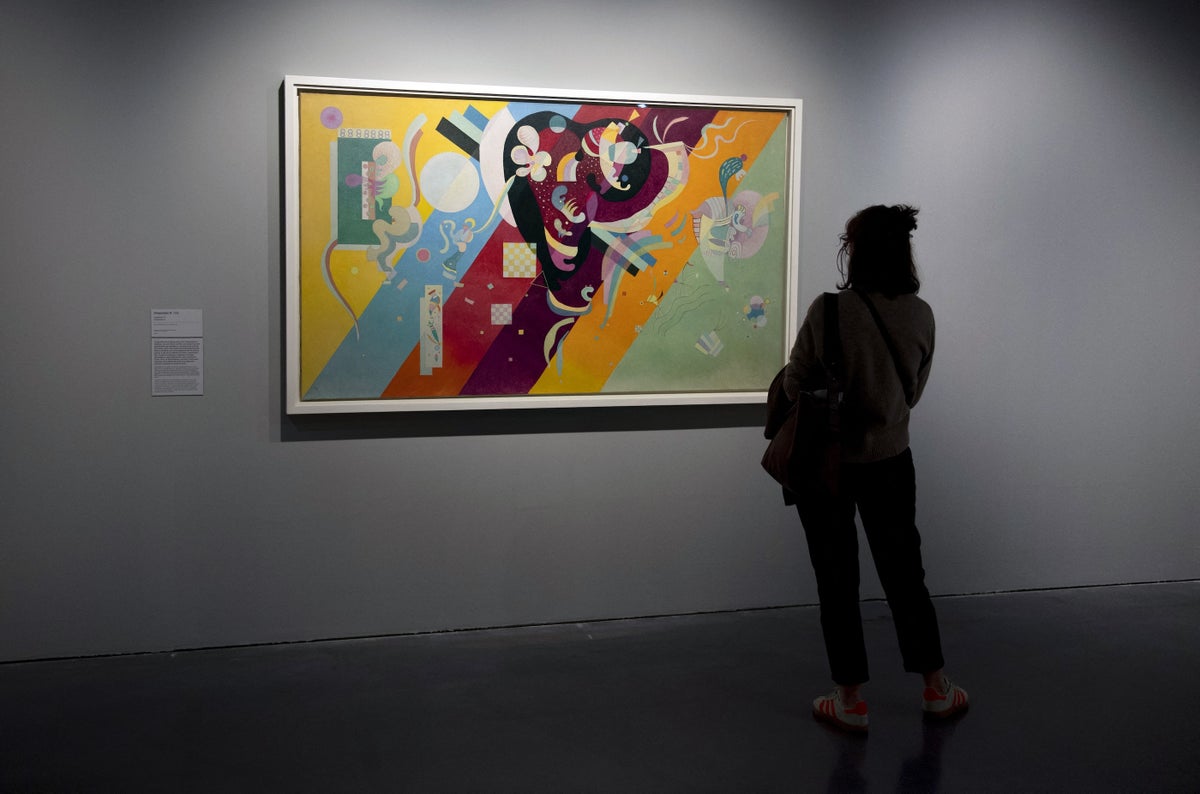
"The team found that viewers were drawn to certain mathematical features of abstract art and that artists created paintings with a remarkably consistent visual balance, whether they were conscious of it or not. At the same time, context matters: the way people responded to human versus AI art depended on whether they saw it on a computer screen, in the lab or in an art gallery."
"Mathematicians have calculated a golden rule for abstract art that famous artists tend to follow when they compose their works. Artificial intelligence, the team found, does not follow such implicit rules about shape placement, possibly explaining why computer-generated art doesn't usually evoke awe from viewers."
"Rogala, co-senior author Shabnam Kadir, a mathematician at the University of Hertfordshire in England, and their colleagues looked to persistent homology, which is part of topology, a mathematical field that studies shapes as they deform and stretch. In this case, the team analyzed the contours of color in the works of Polish artist Lidia Kot."
"Then the researchers compared how people responded to Kot's art and similar AI-generated art both in an art gallery and a lab. On supporting science journalism If you're enjoying this article, consider supporting our award-winning journalism by subscribing. By purchasing a subscription you are helping to ensure the future of impactful stories about the discoveries and ideas shaping our world today."
Researchers examined whether abstract art shares underlying mathematical features that influence emotional response. They used persistent homology, a topology method that studies how shapes change under deformation, to analyze contours of color in works by Polish artist Lidia Kot. They compared audience responses to Kot’s paintings and to similar AI-generated art in both an art gallery and a laboratory setting. Results showed that viewers were drawn to specific mathematical features and that human artists produced paintings with remarkably consistent visual balance, even without necessarily being aware of it. Responses differed for human versus AI art depending on whether the work was viewed on a computer screen, in the lab, or in a gallery.
Read at www.scientificamerican.com
Unable to calculate read time
Collection
[
|
...
]