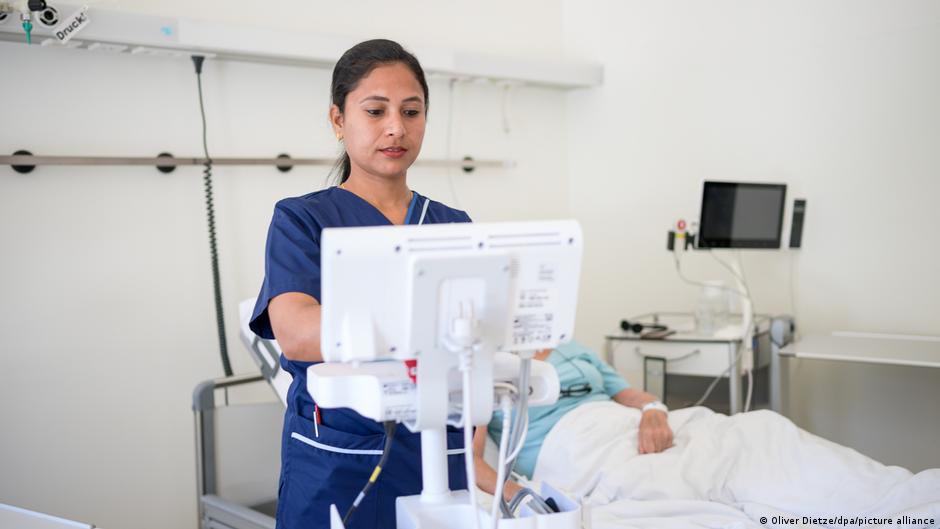
"In a classroom in Chennai, India, around 20 nurses are learning German at breakneck speed. They have six months to become fluent enough to work in Germany. Ramalakshi, one of the nurses, says her family struggled financially, but still managed to pay the equivalent of several thousand euros for her nursing college. Ever since completing her education, she felt the need to give back."
"Germany is desperate for skilled workers, as the country's so-called baby-boomer generation is retiring and leaving the workforce over the next few years, while too few are being born. Hospitals lack nurses, schools need teachers, and the IT sector is crying out for developers. Economists at the Institute for Employment Research (IAB) in Nuremberg, Germany, have estimated that Germany must attract 300,000 skilled workers annually just to maintain the status quo."
In Chennai, about 20 nurses are undergoing intensive German lessons to reach work-ready fluency within six months. A nurse named Ramalakshi aims to work abroad to settle her family financially and build a house after paying for expensive nursing college. The Tamil Nadu government funds the language course to combat local unemployment and expand global job access for disadvantaged families. Private agencies connect trained nurses with employers in Germany. Germany faces an aging workforce and needs around 300,000 skilled workers annually to maintain current economic levels, with shortages across hospitals, schools and IT. Postwar guest worker programs historically helped meet labor demand.
Read at www.dw.com
Unable to calculate read time
Collection
[
|
...
]