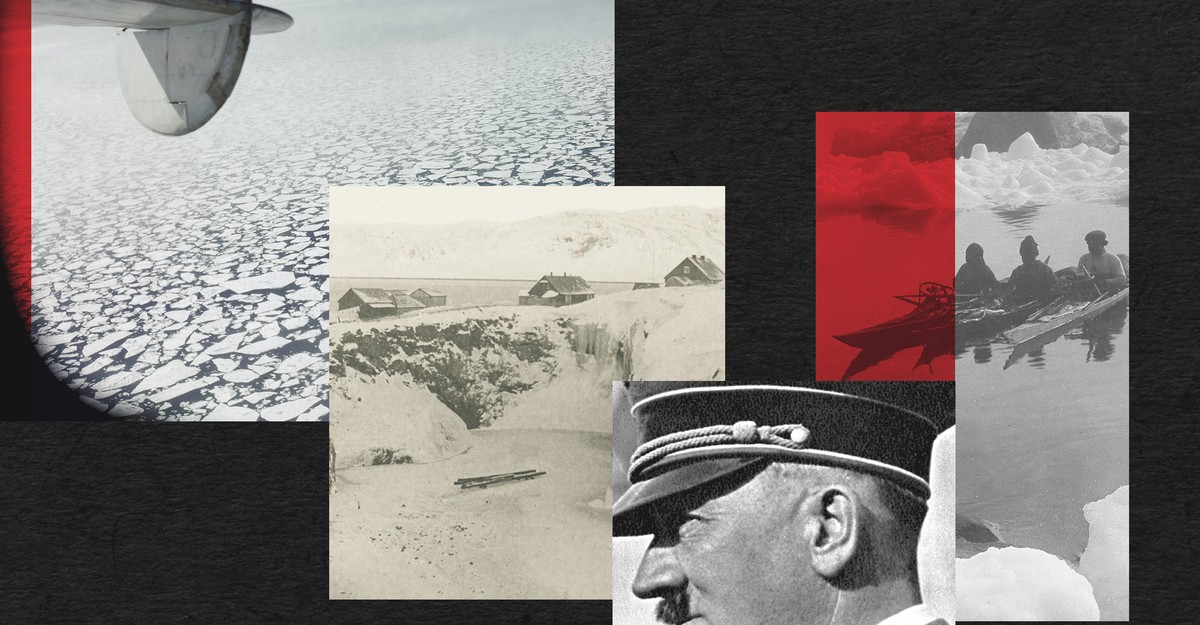
"According to stenographic notes from a lunchtime conversation dated May 21, 1942, Hitler recalled that hardly anyone "interested him more in his youth" than Fridtjof Nansen, the Norwegian explorer who in 1888 led the first team to cross Greenland's interior. A surviving volume from Hitler's private book collection contains firsthand accounts of the geologic and Arctic explorer Alfred Wegener's Grönland Expedition, which left Wegener dead in 1930 and inspired the 1933 adventure film S.O.S. Eisberg, starring the actor and eventual filmmaker Leni Riefenstahl."
"Hitler's personal copy of History of the Expedition, the narrative of the tragic Wegener venture, can be perused in the rare-book collection at the Library of Congress among the 1,200 or so remnant volumes from Hitler's private library. The 198-page monograph bears his personal bookplate-ex libris, eagle, swastika-like many of the others, but is notable because unlike most, it does not include a handwritten inscription by an author, a close associate, or a distant admirer."
Greenland attracted sustained interest from Adolf Hitler, who admired early polar explorers such as Fridtjof Nansen. Hitler owned Alfred Wegener's Grönland Expedition narrative, a 198-page monograph in his private collection that lacks the customary inscriptions, suggesting a personal purchase dated 1933. By April 1934, Nazi authorities had catalogued Greenland's population and resources and identified vast cryolite deposits valuable for aluminum production. In 1938 Hermann Göring sent an expedition to Greenland led by a mining engineer, indicating economic and strategic motives tied to mineral extraction rather than purely scientific objectives.
Read at The Atlantic
Unable to calculate read time
Collection
[
|
...
]