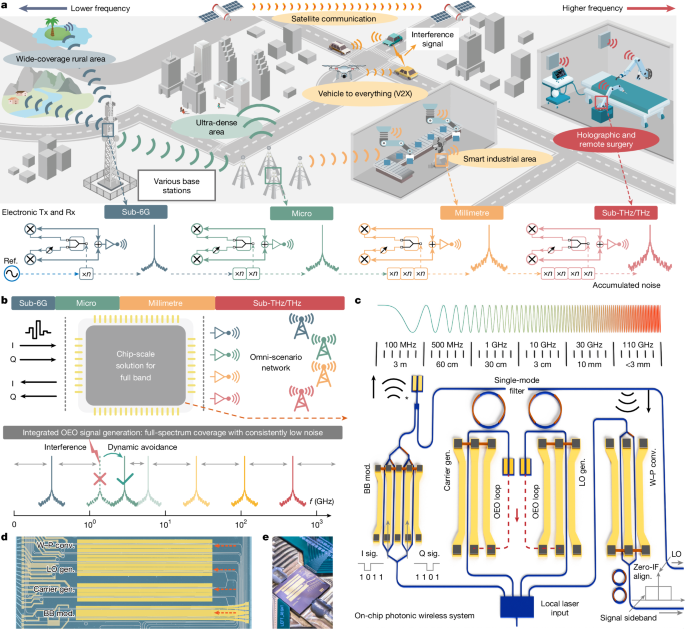
"To meet the growing demand for ubiquitous access, future sixth-generation (6G) and beyond (XG) networks are anticipated to adaptively use full-spectrum resources for diverse application scenarios1,2,3 (Fig. 1a). For example, high-frequency millimetre wave and sub-terahertz bands will provide further increased data speed and reduced latency, facilitating emerging data-intensive services such as extended reality (XR) and remote surgery8. Meanwhile, the low-loss sub-6 GHz and microwave bands continue to provide wide spatial coverage in rural areas or urban centres9,10."
"To support this adaptive full-spectrum vision, a one-size-fits-all hardware solution that can be reconfigured to operate within the entire spectrum is much desired4. Specifically, it should support high fidelity and broadband conversion between baseband and radio frequency (RF) bands, low-noise signal sources with wideband tunability and consistent performance, as well as low-cost chip-scale integrability that seamlessly combines all these essential functions in a small form factor for synergistic operation."
Future 6G and XG networks require adaptive use of full-spectrum resources spanning sub-6 GHz to sub-THz to support diverse applications such as XR and remote surgery. Traditional electrical schemes need distinct device sets per band and accumulate noise at high frequencies via multiplier-based sources. An integrated photonic approach uses a broadband optoelectronic oscillator to generate tunable, low-noise signals across the full band and enables high-fidelity, broadband conversion between baseband and RF. The hardware should offer wideband tunability, consistent low-noise performance, real-time spectral reconfigurability, and low-cost chip-scale integrability for compact, synergistic operation across frequency bands.
Read at Nature
Unable to calculate read time
Collection
[
|
...
]