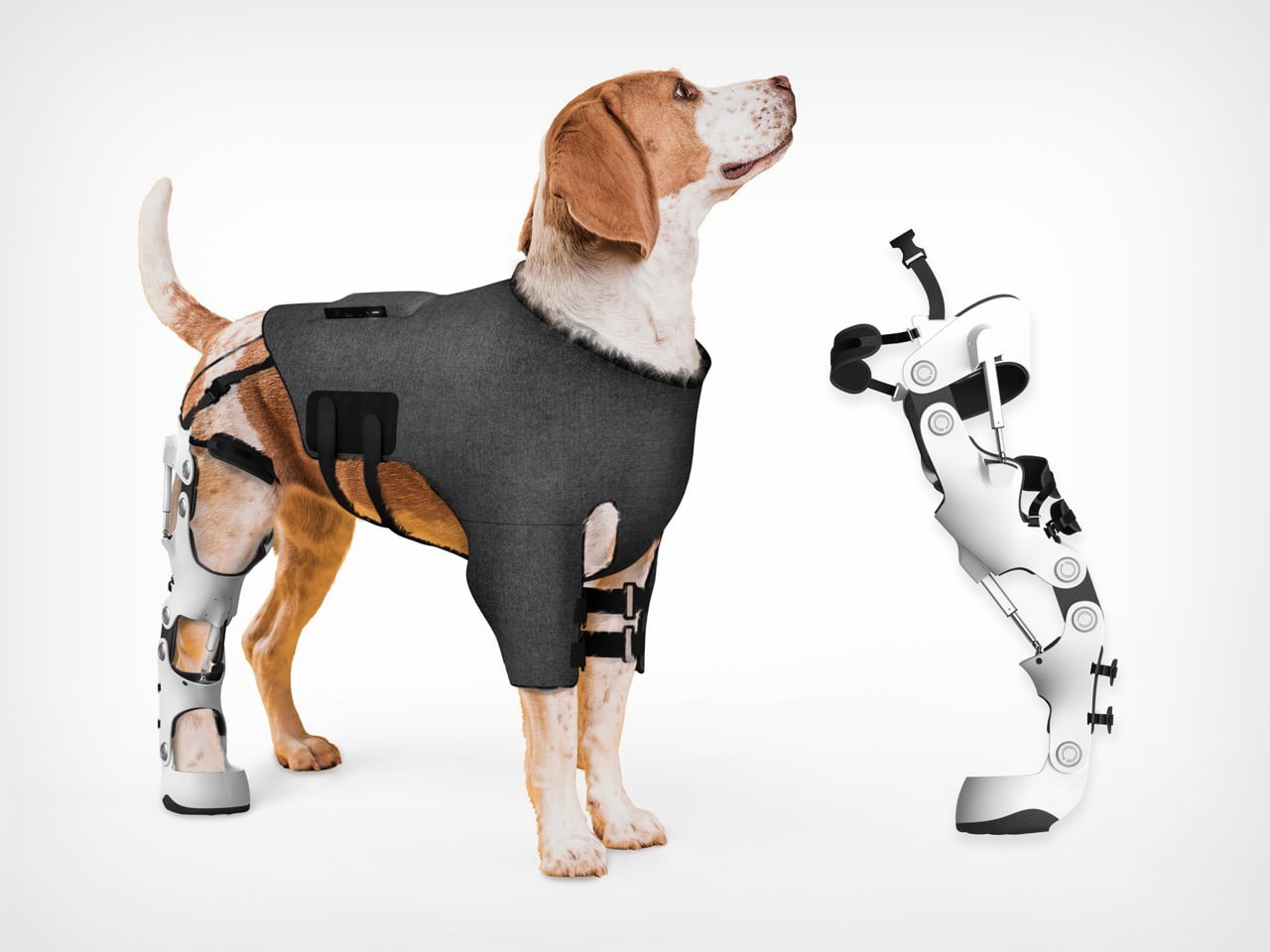
Seeing limitations of passive pet prosthetics and caring for an injured dog motivated development of an assistive exoskeleton that prioritizes intention-driven rehabilitation. The device uses surface electromyographic sensors on a healthy forelimb to read muscle signals and analyzes them in real time to predict impaired hindlimb movement. Precision mechanical assistance synchronizes the injured leg with the dog's natural gait, letting the animal lead while technology follows. The cooperative approach reduces strain, reinforces correct gait patterns, and supports faster, more confident recovery. Personalization tailors assistance to each animal's signals and needs to maximize comfort and rehabilitation outcomes. Designer: Leijing Zhou.
"Watching a dog struggle to walk is quietly heartbreaking. Movement, for animals, is not just mobility. It is freedom, confidence, and joy. The Pet Power Assistive Exoskeleton was born from this understanding, blending emotional insight with advanced engineering to create a rehabilitation solution that truly listens to the animal it supports. The project's inspiration traces back to a news report on prosthetic limbs designed for disabled pets."
"Instead of forcing movement, the Pet Power Assistive Exoskeleton focuses on understanding intention. Borrowing principles from active exoskeleton systems used in stroke rehabilitation, the device uses surface electromyographic sensors to read muscle signals from a dog's healthy forelimb. As the dog initiates movement, these signals are analyzed in real time to predict how the impaired hindlimb should move. The system then activates precise mechanical assistance, synchronizing the injured leg with the dog's natural gait."
"While well-intentioned, many of these solutions revealed clear shortcomings. They were passive, rigid, and often uncomfortable, offering limited support beyond basic mobility. This realization became deeply personal when the designer cared for their own dog after a hindlimb injury. Seeing firsthand how difficult recovery could be for an animal exposed a larger issue. Modern rehabilitation technology has evolved rapidly for humans, yet animal care continues to rely on simplified, often outdated aids. This gap sparked a mission to extend intelligent, humane rehabilitation into veterinary practice."
#assistive-exoskeleton #veterinary-rehabilitation #surface-electromyography-semg #intention-driven-control
Read at Yanko Design - Modern Industrial Design News
Unable to calculate read time
Collection
[
|
...
]