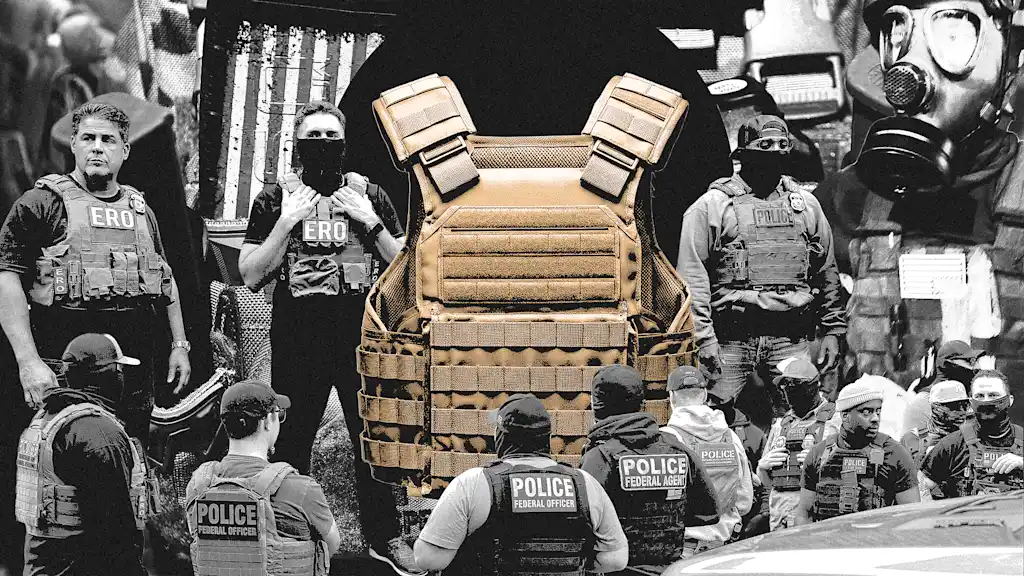
Tactical vests and plate carriers have migrated from combat zones into urban policing and civilian life. Federal officers in Manhattan wore varied tactical vests and inconsistent patches during a Canal Street raid, creating identification ambiguity. A growing consumer market now sells body armor and vest-like garments, and companies that make tactical gear also produce weighted fitness vests. Plate carriers use removable ceramic, steel, or composite plates and MOLLE webbing for modular attachments. The widespread adoption of these garments normalizes militarized aesthetics and reflects a broader cultural shift toward preparedness and securitized fashion.
"In late October, dozens of federal law enforcement officers flooded Canal street, a busy thoroughfare in Manhattan, arresting street vendors. Some officers donned full military uniforms; some wore plain clothes, baseball caps, and neck gaiters pulled over their faces. All were equipped with tactical vests of various styles and with a medley of identifying patches-"HSI," "Customs and Border Patrol," "Federal Agent," or, simply, "Police." They wore markers of power and authority, but with little consistency across them. As news of the raid unfolded, the NYPD released a statement on X saying it had no involvement with the operation. So who, exactly, were all the people with "Police" emblazoned on their chests?"
"Every decade has its era-defining garments. Think spaghetti strap dresses in the 1990s, low-rise jeans in the 2000s, and athleisure in the 2010s. This year, one garment felt suddenly ubiquitous: the tactical vest. And it's not just law enforcement wearing this gear; there's a growing consumer market for body armor and garments that resemble them. They've gone from technical gear designed for professionals to normalized accessories. Moreover, these objects have seeped into fitness in the form of weighted vests that are made by the same companies who produce tactical gear. Their form factor has become a chilling symbol of a political climate defined by fear."
"How the plate carrier mainstreamed These vests, also known as plate carriers, are military equipment designed to protect the people who wear them from bullets and other ballistics. They're garments with removable ceramic, steel, and composite plates, and are outfitted with nylon loops and Velcro that enables wearers to attach gear and accessories, a system known as MOLLE, an acronym for "modular lightweight load-carrying equipment."
Read at Fast Company
Unable to calculate read time
Collection
[
|
...
]