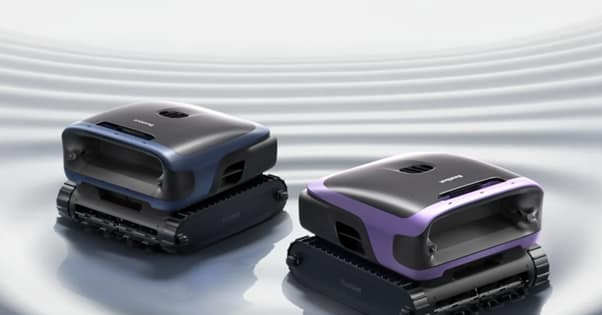
In London's premium residential market, smart homes are judged by invisible infrastructure that self-optimizes and reduces owners' cognitive load. Robotic pool vacuums have transitioned from seasonal gadgets to foundational systems that preserve property value and save time. Premium pool maintenance historically required reactive oversight, manual cleaning, and created recurring interruptions and mental overhead. The 2026 shift emphasizes navigational sovereignty: modern cleaners replace bump-and-turn logic with SLAM-based neural mapping, building a digital twin of the underwater environment and calculating efficient path matrices in real time. Predictive spatial reasoning transforms cleaners into dependable infrastructure that scales efficiency without human intervention.
"In the competitive residential landscape of London, the definition of a "smart home" has undergone a rapid evolution in 2026. For the city's entrepreneurs and high-net-worth individuals, domestic technology is no longer judged by the novelty of voice commands or remote lighting, but by its ability to function as "invisible infrastructure." The goal is a home that self-optimizes, removing the friction of daily maintenance from the owner's cognitive load."
"The disruption in 2026 is driven by the shift toward navigational sovereignty. Modern systems have replaced the randomized "bump-and-turn" logic of the past with sophisticated SLAM-based neural mapping. This allows the device to create a digital twin of its underwater environment, calculating the most efficient path matrix in real-time. By moving away from reactive movement and toward predictive spatial reasoning, the modern cleaner has transformed into a dependable piece of home infrastructure that scales efficiency without human intervention."
Read at London Business News | Londonlovesbusiness.com
Unable to calculate read time
Collection
[
|
...
]