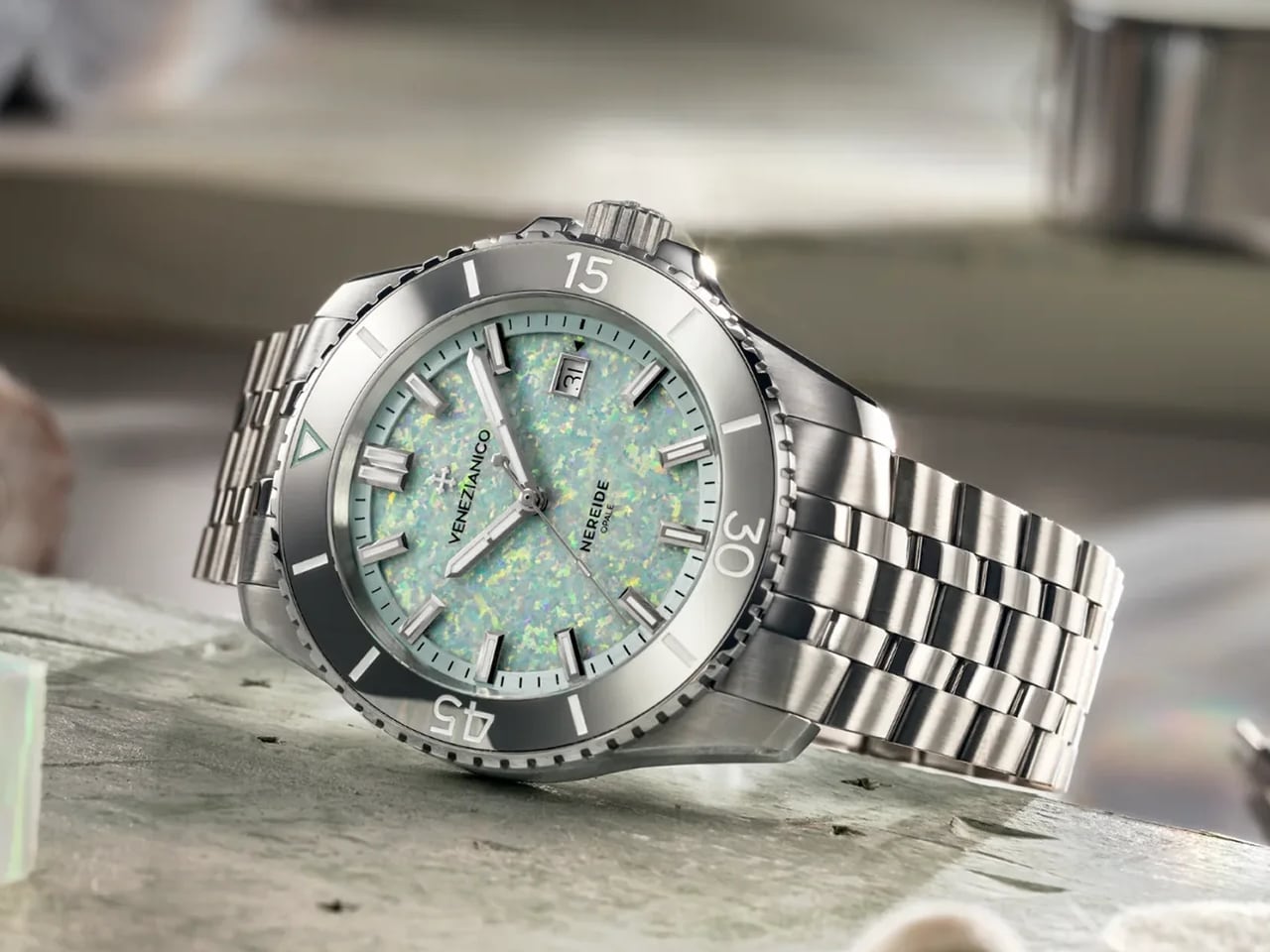
"Most dive watches announce themselves through function: rotating bezels, legible numerals, confidence-inspiring depth ratings. The Nereide Opale acknowledges all of that, then pivots. Venezianico constructed a 200-meter tool watch with a tungsten bezel and Swiss automatic movement, but none of those details survive first contact. The dial dominates. Blue shifts to green shifts to purple shifts to pink as the wrist rotates, a geometric light show housed in familiar steel."
"Natural opal presents challenges for production watchmaking. According to the Gemological Institute of America, high heat or sudden temperature changes can fracture opal and cause crazing, a network of fine cracks that destroys the stone's visual appeal. Add the inconsistency of natural specimens, where one piece might display dramatic fire and the next a muddy gray, and the material becomes impractical for a 500-piece limited run."
"Kyocera, the Japanese ceramics company, developed an alternative decades ago. Their lab-grown material reproduces the layered internal structure that creates opal's color play: light enters, bounces between microscopic layers, and exits as a spectrum of shifting hues. The composition, 80 percent silica and 20 percent clear resin according to Venezianico's specifications, yields a dial plate stable enough to machine cleanly and survive the thermal cycles a dive watch encounters."
Venezianico built the Nereide Opale as a 200-meter dive watch featuring a tungsten bezel and a Swiss automatic movement while foregrounding a vivid, color-shifting dial. The dial shifts from blue to green to purple to pink as the wrist rotates, producing a geometric, highly photogenic effect. The watch targets collectors who already own conventional matte-dial, heritage, or affordable Swiss tool watches and seek a distinct visual centerpiece. Natural opal proved impractical for a 500-piece run due to fragility and variability. Kyocera supplies a lab-grown material of roughly 80 percent silica and 20 percent clear resin that reproduces opal's layered structure while remaining stable and machineable.
Read at Yanko Design - Modern Industrial Design News
Unable to calculate read time
Collection
[
|
...
]