"The Wright Brothers changed the course of history when they took the first ever flight on December 1903. Their biplane, crafted from wood and fabric, had a rudder for yaw control, wing warping for roll control, and front elevators for pitch control. The first flight lasted for just 12 seconds, driven by the custom 12-horsepower engine and propellers. The aviation industry has come a long way since that decisive event, and it's always good to have a similar nostalgic feel again."
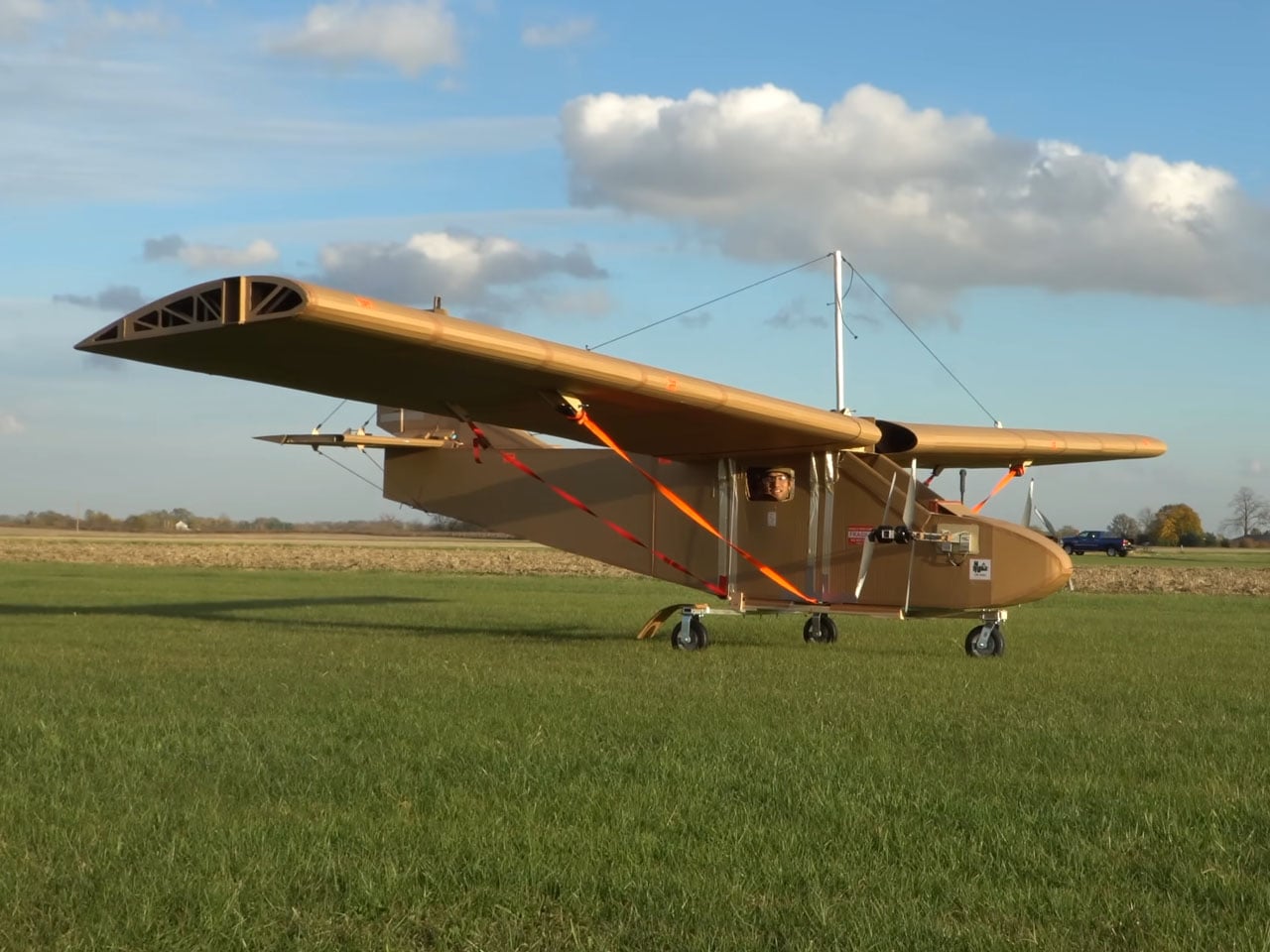
"Peter Sripol, along with his team, has built a cardboard airplane that has plywood-structured wings (just like the Wright Brothers' airplane) and is capable of flying one person with ease. Interestingly, the DIYer uses a Pizza box to fit in the altimeter, air speed gauge, and the attitude indicator. According to his estimation, the plane is a giant shipping box, given that it has around 95 percent cardboard parts, which in itself is a feat."
"The shape of the fully assembled airplane is just like any other double-propeller plane that's commercially produced. It is narrower on the tail end and wider near the seating section for aerodynamic efficiency. Just that it's not as polished and fine-tuned since it is just a prototype for now. After putting together the fuselage, wings, and the custom-made wheel assembly that ejects once the thing is airborne to shed extra weight, Peter drove around the plane in taxing mode to check if all the basics are working fine. The wheels seemed to drag a little."
A mostly-cardboard single-seat airplane with plywood-structured wings was constructed to echo early aviation design. The craft uses wing warping for roll control, a rudder for yaw, and front elevators for pitch, and carries improvised instruments fitted into a Pizza box. Approximately 95 percent of parts are cardboard, with corrugated sections glued for structural integrity and small cutouts for visibility. Prototype features include a detachable wheel assembly to shed weight on takeoff and a custom power system; initial taxi tests revealed wheel drag and insufficient battery power. Short flights were achieved, but directional control issues caused abrupt landings.
Read at Yanko Design - Modern Industrial Design News
Unable to calculate read time
Collection
[
|
...
]