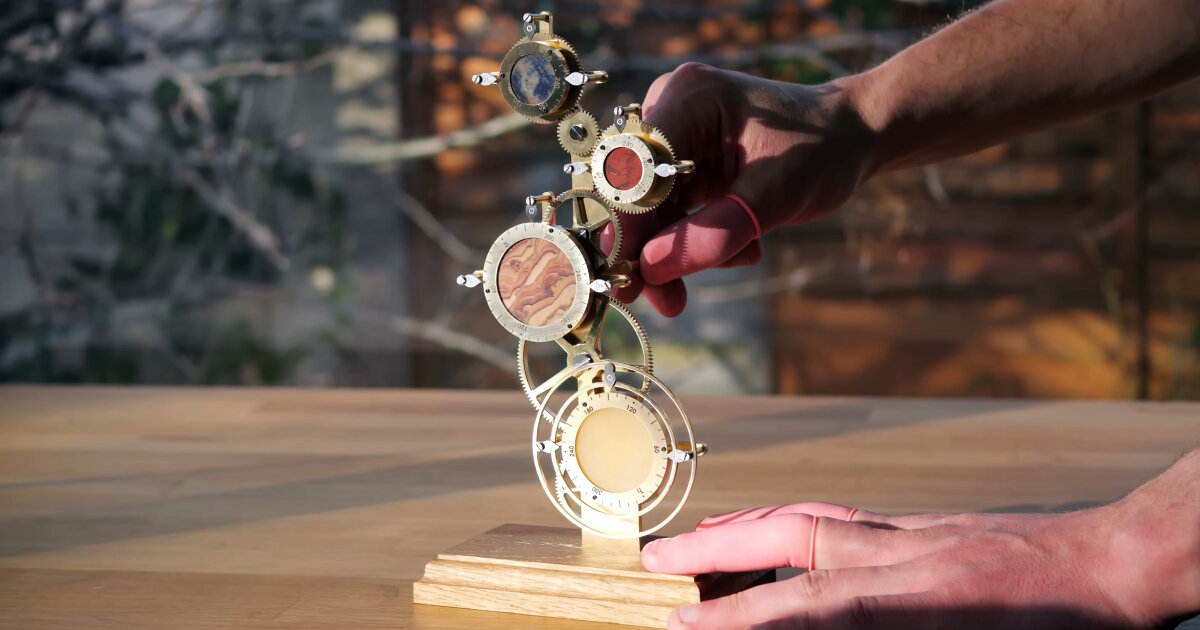
"Since every planet spins at a different speed, the gears are built with different ratios: Earth takes about 24 hours to spin once, Mars takes about 24.6 hours, Jupiter spins much faster, and Saturn spins fast too. Because of this, each dial shows the real day cycle of that planet, so the clock doesn't calculate time digitally."
"The mechanical clock that tells other planets' time stands on a wooden base and rises in a vertical line. Different gears hold a set of round dials, which represent a planet. The user makes the mechanical clock work by rotating the lever at the back, and after that, time is told across planets through the rotation and using the markers around the dial."
"The clock has 131 parts, and all of them move through mechanical movement. There is no screen. There are no electronic parts. The system depends on gears to control rotation speed."
Chronova Engineering designed a mechanical interplanetary clock that displays the time on different planets through rotating dials and interconnected gears. Each planet has its own dial representing its unique rotational speed: Earth rotates in approximately 24 hours, Mars in 24.6 hours, while Jupiter and Saturn spin faster. The device contains 131 mechanical parts with no electronic components or digital displays. Users operate the clock by rotating a lever, which drives the gear system to move the dials at speeds corresponding to each planet's axial spin. The dials are marked with longitude references similar to Earth's prime meridian system, allowing the clock to accurately represent day-night cycles across the solar system through pure mechanical movement.
#mechanical-engineering #planetary-timekeeping #gear-systems #interplanetary-device #analog-clock-design
Read at designboom | architecture & design magazine
Unable to calculate read time
Collection
[
|
...
]