"The company's 12th- and 13th-generation Core chips offered big boosts to CPU performance over the 11th-generation CPUs, for example, but they also usually came with a significant hit to battery life, and they only minimally improved the GPU. The first-generation Core Ultra chips, codenamed Meteor Lake, improved the GPU but couldn't beat the CPU performance of older chips. Last year's Core Ultra 200V series, codenamed Lunar Lake, boasted good battery life and solid graphics performance but weaker CPU performance;"
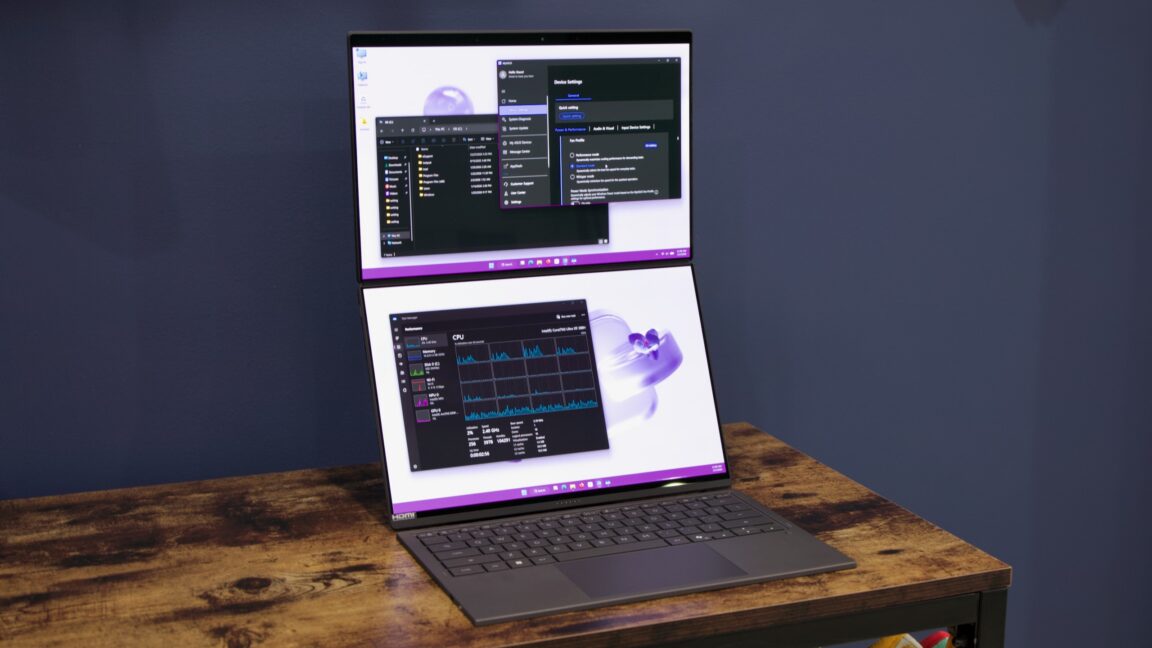
"Intel provided us with its best Panther Lake chip for testing-a Core Ultra X9 388H, ensconced in the odd-but-compelling Asus Zenbook Duo UX8407. And at least in this form, Panther Lake is mostly excellent, with CPU and graphics performance that easily outstrips the last few generations of Intel chips and is more than competitive with AMD's Ryzen AI 300 and 400 processors. Power efficiency and battery life are also excellent, at least based on our sample size of one laptop."
Intel's Core Ultra Series 3 processors, codenamed Panther Lake, deliver balanced and substantial improvements across CPU and GPU performance. A tested Core Ultra X9 388H in an Asus Zenbook Duo UX8407 showed CPU and graphics performance that outstrips recent Intel generations and competes with AMD's Ryzen AI 300 and 400 series. Power efficiency and battery life were excellent on the tested laptop. Prior Intel generations produced uneven trade-offs: 12th/13th improved CPU but hurt battery life with minimal GPU gains; Meteor Lake improved GPU but lagged in CPU; Lunar Lake favored battery and graphics but had weaker CPU; Arrow Lake raised CPU at the cost of GPUs and features. Panther Lake needs to become the steady baseline for future iterations rather than an outlier.
Read at Ars Technica
Unable to calculate read time
Collection
[
|
...
]