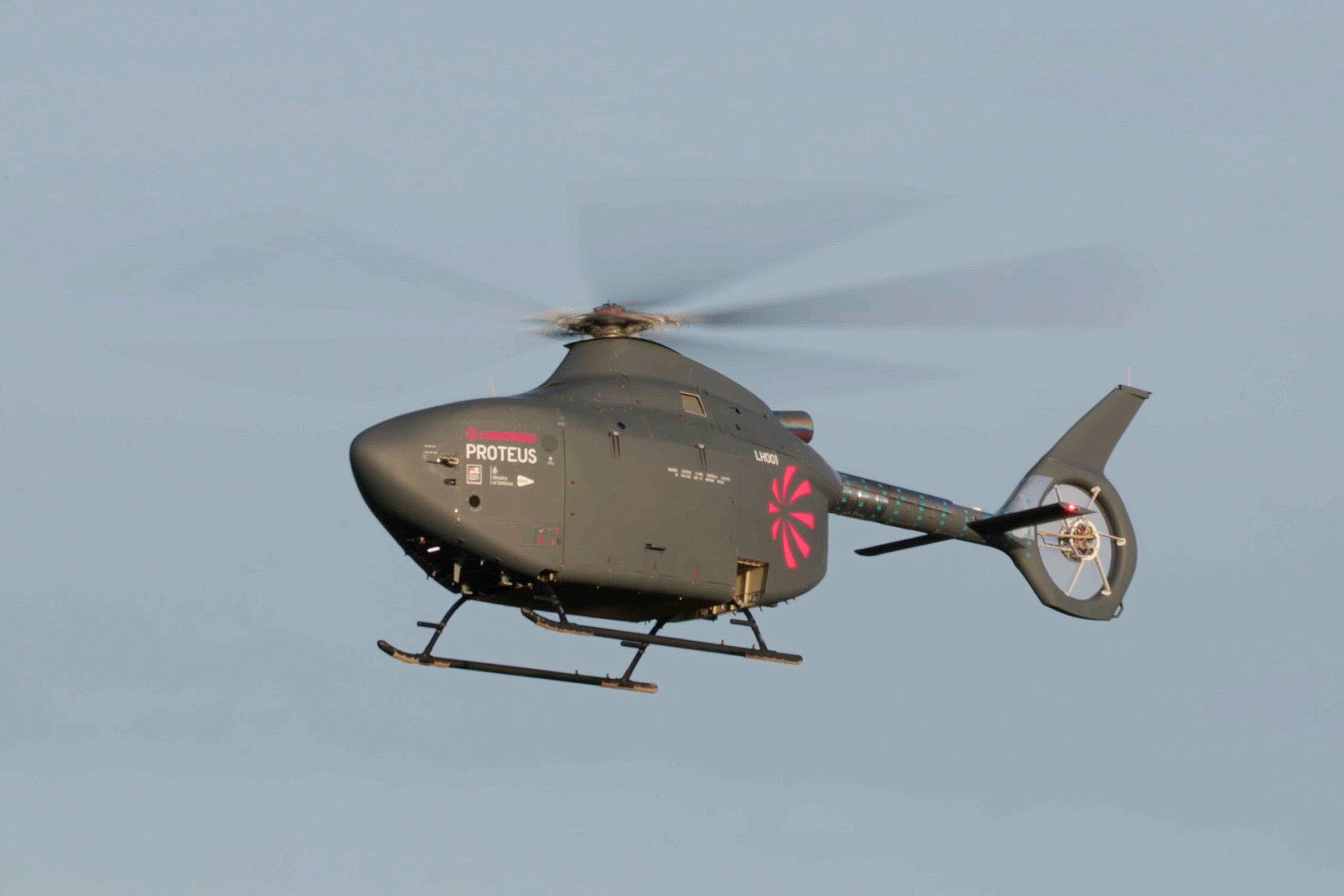
"Currently known as Proteus, the drone has now completed its first flight at Predannack Airfield on the Lizard peninsula in Cornwall, in the southwest of the UK. This follows "ground running" trials at Leonardo's Yeovil site in Somerset - where the helicopter's systems, sensors and engine were all verified before it was allowed to take to the air. Its first flight was seemingly brief. The aircraft was tasked with a short test routine operating independently of human"
"As well as omitting the crew cabin in place of computerised control and navigation systems, Proteus features a modular payload bay where you would otherwise expect passengers to be seated. This is intended to provide flexibility in mission roles, allowing different payloads to be carried by swapping out one module for another one. These mission roles are likely to include ferrying cargo between Royal Navy ships, or a payload module designed to deploy sonobuoy sensors that are used to detect and track submarines, among others."
"Proteus was designed and built as a demonstrator for the Royal Navy by defense firm Leonardo, the successor to Westland Helicopters. Unlike some other rotary-wing drones already in service, it is based on an existing crewed helicopter design, Leonardo's AW09 light single-engine aircraft. The Royal Navy already operates other, smaller drones such as the Malloy T-150 and Peregrine, a remotely operated helicopter drone that has seen service in the Indian Ocean and Gulf of Oman providing surveillance support for missions targeting drug trafficking."
Proteus completed its first flight at Predannack Airfield following "ground running" trials at Leonardo's Yeovil site where systems, sensors and the engine were verified. The platform is an uncrewed demonstrator derived from Leonardo's AW09 light single-engine helicopter and replaces the crew cabin with computerised control and navigation systems. A modular payload bay allows rapid swapping of mission modules for roles such as ship-to-ship cargo transfers or deploying sonobuoys to detect and track submarines. The demonstrator is part of a £60 million program to deliver Rotary Wing Uncrewed Air Systems for the Royal Navy. Initial flight testing was brief and autonomous.
Read at Theregister
Unable to calculate read time
Collection
[
|
...
]