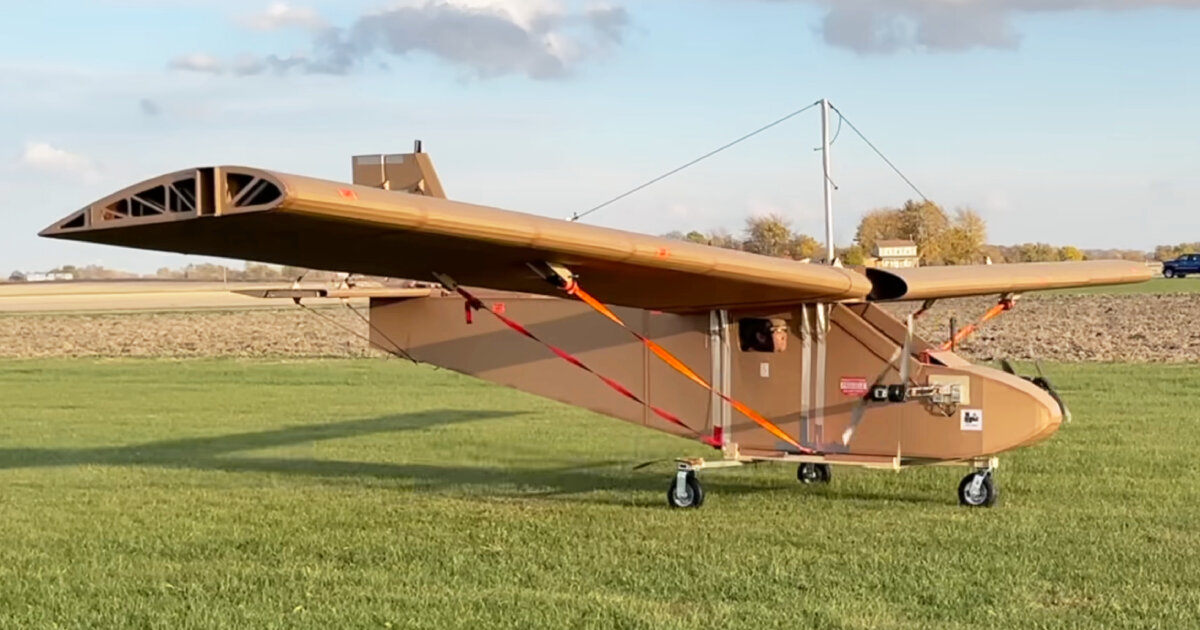
"The cardboard airplane with wooden wings attempts to fly in the sky using a remote control and a set of exposed propellers. Built by Peter Sripol and his team, the personal air vehicle is lightweight enough to carry one person to the sky, or at least it tries. The project begins with the fuselage, which is built entirely from cardboard panels cut into side profiles and glued together."
"The shape follows a simple airplane body form that narrows toward the tail and widens near the seating area, and the team reinforces high-load areas using doubled, tripled, and stacked layers of cardboard. These reinforcements are placed where the pilot sits, where the wings connect, and where the landing loads are transferred. Then, hot glue is used as the main adhesive because it sets quickly and allows them to assemble the cardboard airplane with wooden wings as quickly as possible."
"The two-part videos document how the cardboard airplane with wooden wings comes to life. The first part focuses on the design of the personal aircraft and in the second part, the creator Peter Sripol sits inside it to test if it can fly. These clips show the team designing a layered floor with internal cardboard ribs arranged like corrugated slats to create a box structure that can support the pilot's weight without collapsing."
The fuselage is constructed from cardboard panels cut into side profiles and glued together to form a narrowed tail and widened seating area. High-load zones are reinforced with doubled, tripled, and stacked cardboard layers at the pilot bay, wing attachment points, and landing load paths. A layered floor with internal cardboard ribs creates a box structure to support pilot weight. Wooden wings incorporate embedded plywood plates and reinforced cardboard doublers, and they are bolted to the fuselage. Hot glue serves as the primary adhesive to speed assembly. Controls are side-mounted with planned rudder pedals, small cutouts provide limited visibility, and intended flights are straight, short, and low.
Read at designboom | architecture & design magazine
Unable to calculate read time
Collection
[
|
...
]