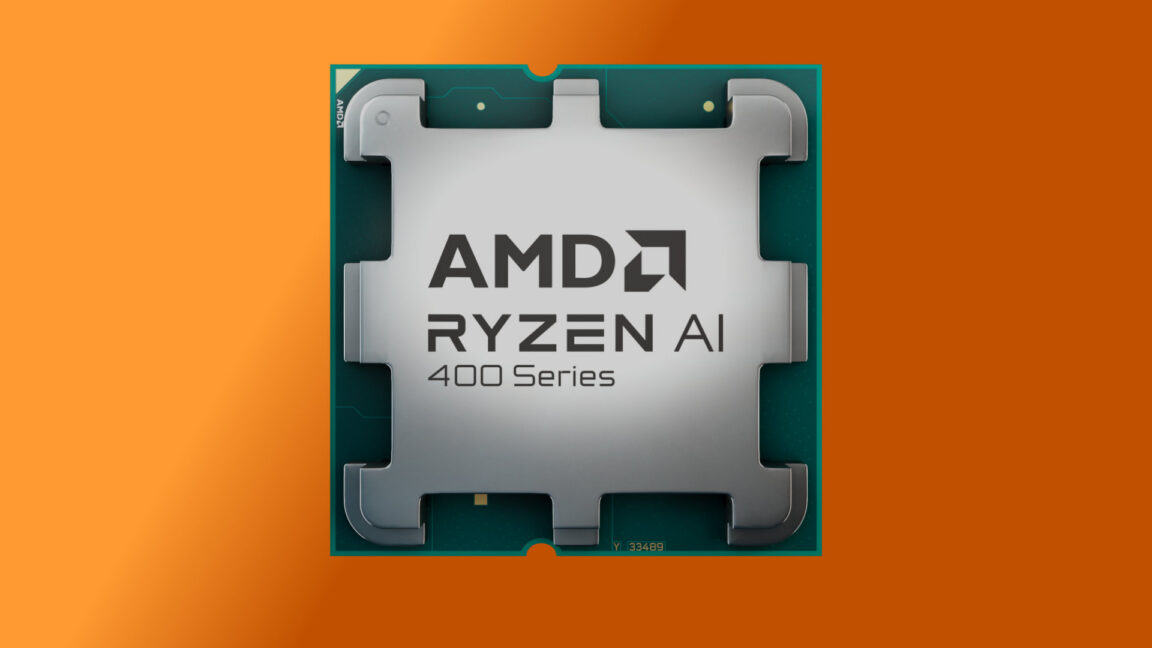
"Like past G-series Ryzen chips, these are essentially laptop silicon repackaged for desktop systems. They share most of their specs in common with Ryzen AI 300 laptop processors, despite their Ryzen AI 400-series branding. The two chip generations are extremely similar overall, but the Ryzen AI 400-series laptop CPUs include slightly faster 55 TOPS NPUs."
"Unlike past launches, AMD is not providing its top-end laptop silicon for desktop use, at least not yet. None of these chips include the full compliment of 12 CPU cores that you can get in the Ryzen AI 9 HX 375 or 370; you also can't get the Radeon 880M or Radeon 890M integrated GPUs. The three models AMD is announcing today top out at 8 CPU cores and a Radeon 860M integrated GPU with 8 RDNA 3.5 graphics cores."
"It's hard to make any kind of gaming PC make financial sense right now, but the frames-per-second-per-dollar you get from a desktop iGPU make them particularly unappealing. This may explain why the CPUs are targeting business desktops first."
AMD's Ryzen AI 400-series desktop processors are essentially laptop silicon repackaged for desktop systems, sharing most specifications with Ryzen AI 300 laptop processors despite different branding. These chips feature up to 8 CPU cores split between faster Zen 5 and more efficient Zen 5c cores, paired with Radeon 860M integrated GPUs. Unlike previous launches, AMD is not providing its top-end laptop silicon for desktop use, omitting the 12-core configurations and higher-end Radeon 880M or 890M GPUs available in laptop variants. The focus on business desktops rather than gaming reflects financial constraints, as expensive DDR5 memory requirements make gaming PC builds economically unfeasible. This conservative approach aligns with AMD's CES announcements of incremental technology iterations amid manufacturing capacity constraints at TSMC.
#ryzen-ai-400-series #desktop-processors #integrated-graphics #business-computing #ddr5-memory-pricing
Read at Ars Technica
Unable to calculate read time
Collection
[
|
...
]