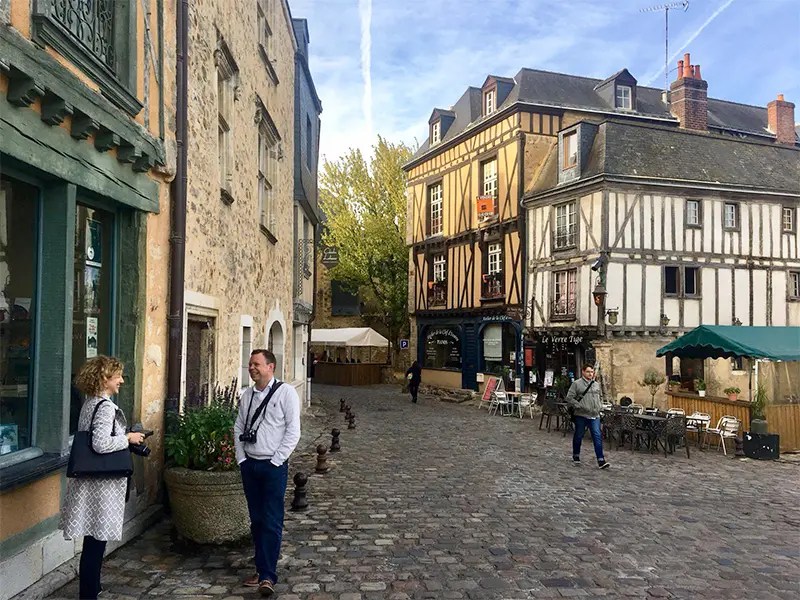
"In the early years of the 20 th century, this historic town in the Sarthe department was the cradle of motoring innovation, birthplace in 1906 of the Automobile Club de l'Ouest or ACO. In 1923, the club launched a 24-hour endurance race designed to test the capabilities of different models and over a century later, enthusiasts come from across the world to enjoy the atmosphere of Les 24 Heures du Mans in early June and tour the race museum throughout the year."
"But Le Mans offers more than just motoring. You never forget your first sight of the city's spectacular Roman walls, built at the end of the 3 rd century AD with round towers and geometric patterns in coloured bricks. Visit in July and August to enjoy Les Nuits des Chimères (wild dreams), a free light show of moving images projected onto the city walls, cathedral and other historic sites."
"Head inside those ramparts and the surprises just keep on coming. Le Mans was the home of the Plantagenet dynasty, so called because Geoffrey, Count of Anjou, would plant a spring of broom or genet in his hat as he returned from hunting. In 1126, Geoffrey married Matilda, widow of English king Henry V and granddaughter of William I, first Norman king of England."
France offers diverse city breaks ranging from major cities to smaller towns. Le Mans in Sarthe combines motorsport heritage with medieval architecture. The Automobile Club de l'Ouest was founded in 1906 and launched the 24-hour endurance race in 1923, attracting global enthusiasts each June and supporting a year-round race museum. The city features spectacular Roman walls from the late 3rd century AD, with round towers and coloured-brick geometric patterns, and a free summer light show called Les Nuits des Chimères. Le Mans was home to the Plantagenet dynasty; Geoffrey of Anjou married Matilda and was buried in the Romanesque Cathedral of Saint-Julien.
Read at The Good Life France
Unable to calculate read time
Collection
[
|
...
]