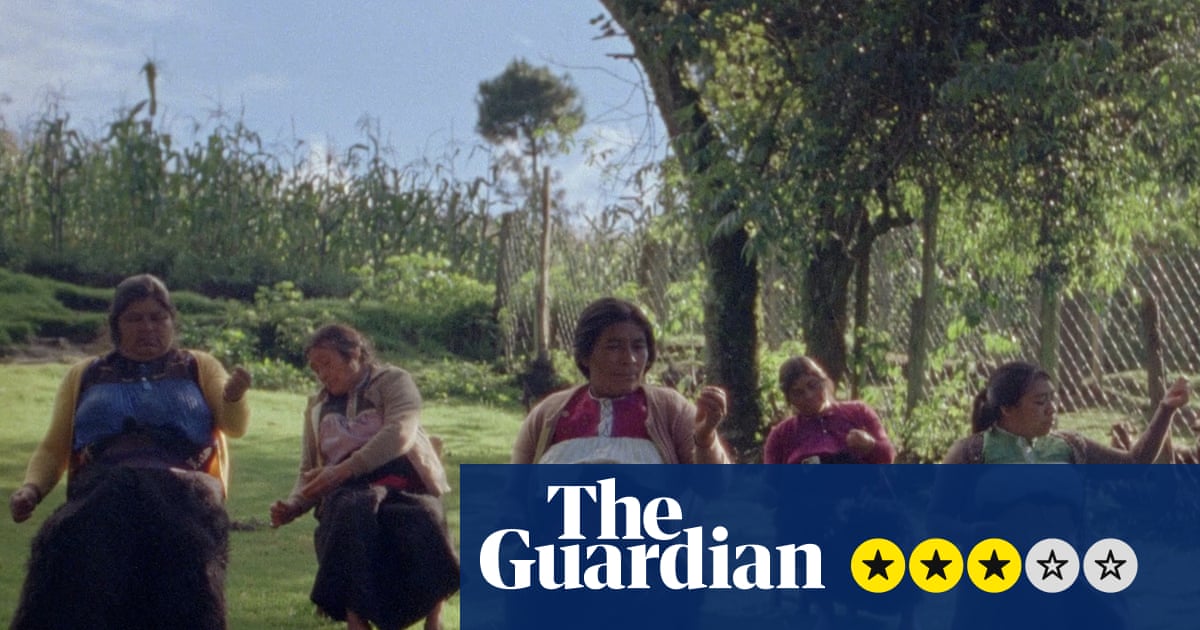
"Here dwells the indigenous Tzotzil community which has kept a pastoral way of life against the march of time. Apart from the odd forest ranger and passerby, Ruvalcaba's film focuses almost entirely on the Tzotzil women. Together, they tend herds of sheep which they still shear by hand, and use traditional tools for spinning yarns and natural dye for fabrics."
"The women are often pictured in wide shots that take in the majestic landscape that surrounds them, furthering the deep relationship between the Tsotsil community and their environment in which natural resources are treated with care and respect. At the same time, Chiapas is far from an idyll. One woman says that, although they are now treated by nonindigenous people with more respect, discrimination still exists."
Set among the mossy hills of Chiapas, the documentary centers on Tzotzil women who preserve a pastoral way of life through hand-shearing sheep, traditional spinning tools and natural dyeing. Wide landscape shots emphasize a deep relationship with the environment and careful use of natural resources. The film acknowledges discrimination from nonindigenous people and internal gender inequality that limits education. Historic trails and the camera function as metaphoric crossings; the director, raised locally yet not taught about Indigenous communities, uses filmmaking as a conduit to bridge knowledge gaps. A moment flips the ethnographic gaze when women comment on the camera, likening filmmaking to artisanal weaving. True Story screening from 27 February.
Read at www.theguardian.com
Unable to calculate read time
Collection
[
|
...
]