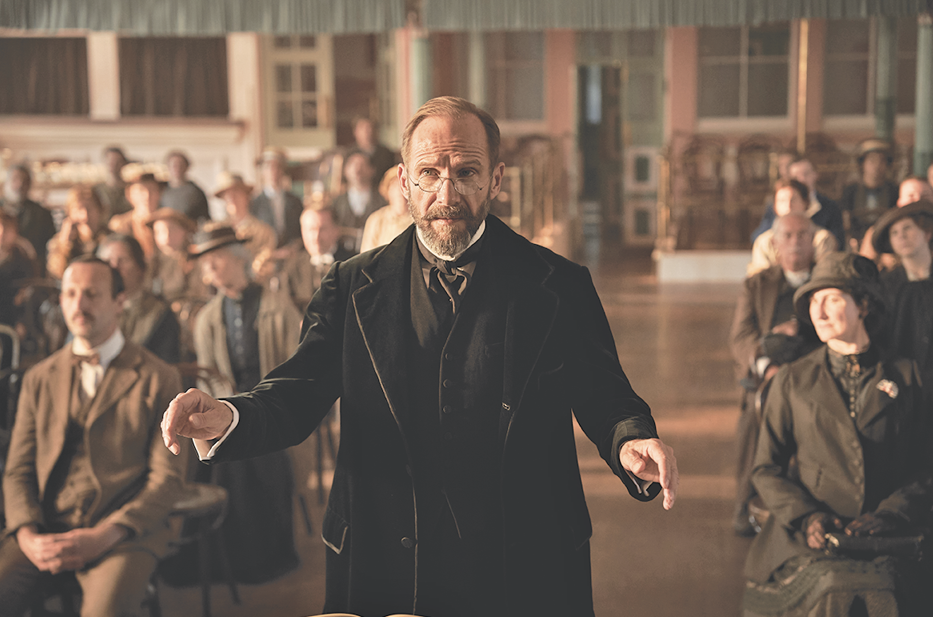
"He reluctantly agrees to bring in Dr. Guthrie (Ralph Fiennes), but Guthrie is a bit of an outcast; not only did he spend years in-gasp!-Germany, but he is "not a family man." (That is code for gay; the film does not speak about "the love that dare not speak its name.") A subplot involves Guthrie regularly checking on his German "friend" (code for lover) who enlisted in the war. Their relationship is discretely implied, as is the sexuality of Guthrie's current pianist, Robert Horner (Robert Emms), who tells Guthrie that he would like to be his "friend," but Guthrie denies him."
"Robert instead becomes a conscientious objector when he gets called up to war. During his interview with the board, he is asked questions about sports and if he is a vegetarian, as if to queer bait him. Robert sticks to the courage of his convictions, acknowledging that it will result in punishment. The Choral downplays the homosexuality and focuses on the relationships of the straight (and horny) young men in the chorus. Lofty (Olvier Briscombe) wants to lose his virginity before he goes off to war."
The Choral is set in 1916 Ramden, Yorkshire, where Alderman Duxbury aims to stage a performance of St. Matthew Passion and recruit male singers from a depleted town. Duxbury reluctantly brings in Dr. Guthrie, an outcast who spent years in Germany and is described as "not a family man," with his sexuality implied rather than named. Guthrie maintains a discreet relationship with a German "friend," while pianist Robert Horner seeks Guthrie's friendship and later declares conscientious objection, accepting punishment. The film minimizes explicit homosexual themes and emphasizes the romantic and sexual anxieties of the straight young chorus members, leaving the musical premise emotionally muted.
Read at San Francisco Bay Times
Unable to calculate read time
Collection
[
|
...
]