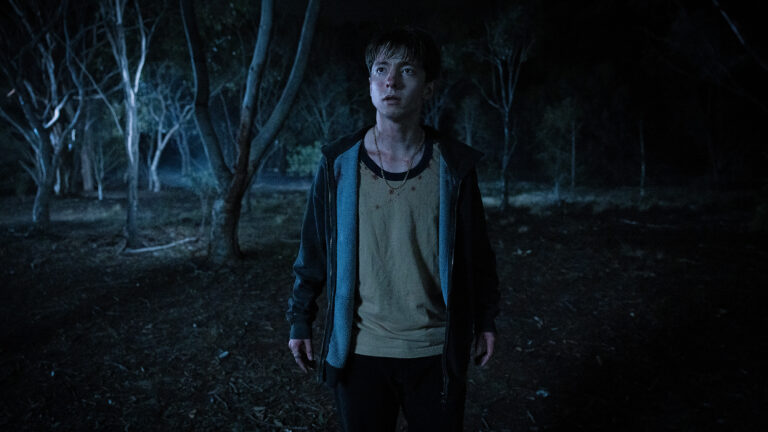
"In a small Australian town, two queer kids-Naim (Joe Bird) and Ryan (Stacy Clausen)-share furtive glances and intense kisses in an abandoned mill. Oftentimes, violence, like the rough play fighting they often engage in, incites their sexual passions, which they must conceal in their fiercely religious town. Their adolescent passion turns deadly, however, when Naim discovers Ryan cheating on him with the preacher's son; so naturally the jilted teenager spitefully reports his lover's tryst."
"The solution by the preacher is to call a deliverance healer to "pray the gay away." This healer's spell, in actuality, is a curse-causing the bearer to see visions that turn their desires murderously onto them. The simple premise in " Leviticus," a film by writer/director Adrian Chiarella, often recalls "It Follows." There is seemingly no way to shake this malicious presence; though it appears to the afflicted, it's never visible when others are around."
"To visually demonstrate the kind of violent isolation that occurs for a queer kid in a rural community where they're forced to remain closeted, Chiarella often leans on frames featuring heavy negative space, whose only occupant is a single person. In that way, the director crafts a firm world, earning the leeway required to believe that Naim and Ryan's longing would be strong enough to continually put themselves in harm's way."
Leviticus follows two queer teenagers, Naim and Ryan, who meet secretly in an abandoned mill in a fiercely religious Australian town. After Naim discovers Ryan with the preacher's son, the preacher summons a deliverance healer whose ritual functions as a curse, causing afflicted individuals to experience murderous visions tied to their desires. The film evokes It Follows in its unshakable malignancy that appears only to victims. The director uses heavy negative space and isolated framings to convey violent isolation and the risks of closeted longing in a rural environment.
Read at Roger Ebert
Unable to calculate read time
Collection
[
|
...
]