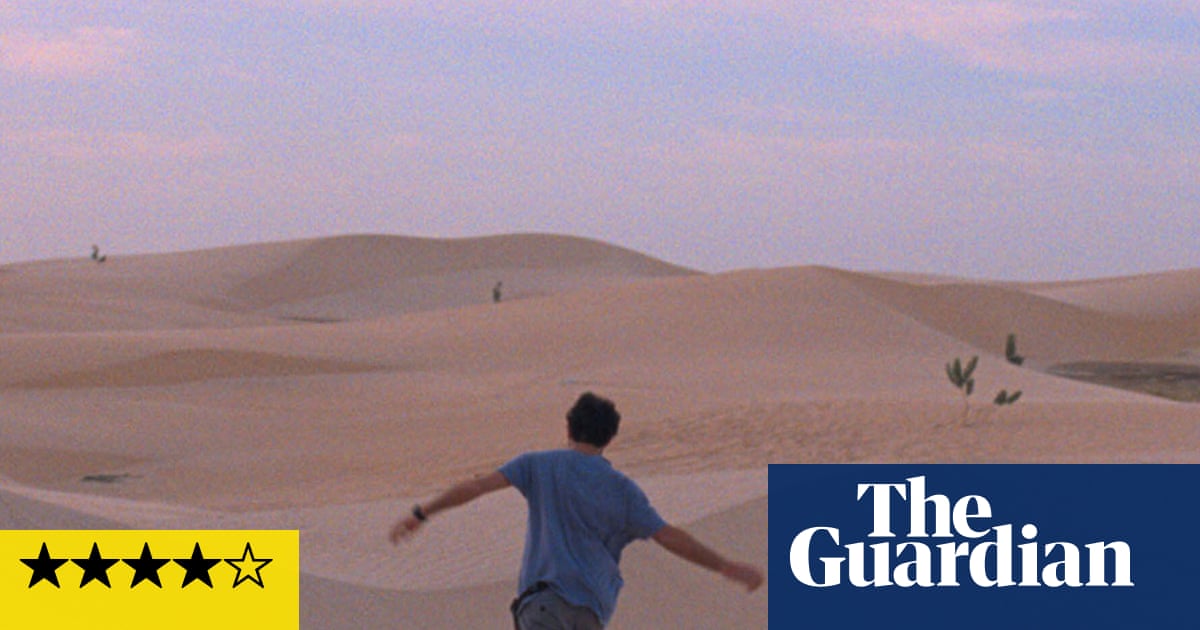
"First seen driving through a sand blizzard like one of Antonioni's existential wanderers, Sergio seems to want to avoid thinking about the power dynamics at play around him. Being here now, in the moment, is his superpower as he tells Gui (Jonathan Guilherme), the lofty Brazilian drag queen he dallies with. Gui's gender-fluid posse, who hang out at the bar run by market hustler Diara (Cleo Diara), is a racial and sexual utopia ready to accept anyone, including this white expat."
"But, as Gui intuits, Sergio's bisexuality mirrors something noncommittal, even opportunistic, about him. He both lives in the expat enclave and the streets, without belonging to either. But Sergio's nonaligned status makes him the perfect vehicle to eavesdrop on postcolonial relations in all quarters. Opinion is divided on whether the road will be an economic boost or an environmental blight; questions underscored by poverty, corruption and violence, as emphasised by the mysterious disappearance of Sergio's predecessor; smooth local businessman Horatio, hymning progress, won't discuss this."
Sergio, a Portuguese environmental engineer, struggles with sexual impotence and mounting doubt about his role while working on a road construction project in Guinea-Bissau. He drifts between an expat enclave and the streets, forming casual ties with Gui, a Brazilian drag queen, and Diara, a market hustler, without belonging to either world. Debates over the road—economic boon or environmental blight—intersect with poverty, corruption and violence, underscored by the mysterious disappearance of Sergio's predecessor. White hypocrisy and Western paternalism surface through offers of bribes and moral self-flagellation, revealing complex postcolonial power dynamics and moral ambiguity.
Read at www.theguardian.com
Unable to calculate read time
Collection
[
|
...
]