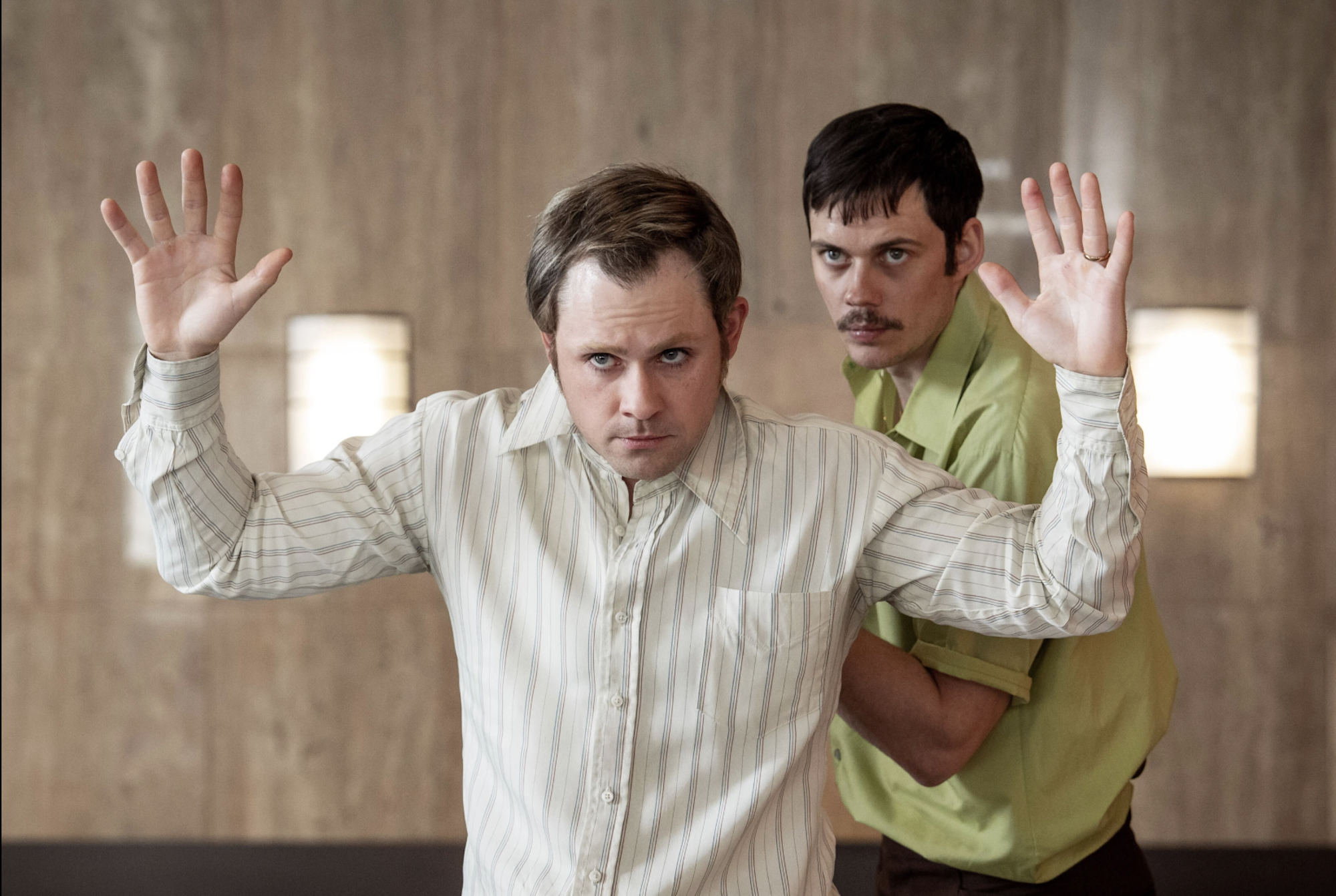
"The subsequent standoff moved to Kiritsis' apartment and eventually concluded in a live televised news conference. The whole ordeal received some renewed attention in a 2022 podcast dramatization starring Jon Hamm. That's owed significantly to Skarsgård, who gives one of his finest and least adorned performances. While best known for films like It, The Crow and Nosferatu, here Skarsgård has little more than some green polyester and a very '70s mustache to alter his looks. The straightforward, jittery intensity of his performance propels Dead Man's Wire."
"Pacino's presence in Dead Man's Wire is a nod to Dog Day Afternoon, a movie that may be far better - but, then again, that's true of most films in comparison to Sidney Lumet's unsurpassed 1975 classic. Still, Van Sant's film bears some of the same rage and disillusionment with the meatgrinder of capitalism as Dog Day."
"There's also a telling, if not entirely successful subplot of a local TV news reporter (Myha'la) struggling against stereotypes. Even when she gets the goods on the unspooling news story, the way her producer says to "chop it up" and put it on air makes it clear: Whatever Tony is rebelling against, it's him, not his plight, that will be served up on a prime-time plate."
Dead Man's Wire blends 1970s aesthetics with a contemporary, based-on-a-true-tale hostage thriller. Bill Skarsgård delivers a jittery, unadorned lead performance that drives the film. Al Pacino appears as an intertextual nod to Dog Day Afternoon, and the movie echoes that film's rage and disillusionment with the meatgrinder of capitalism. A subplot follows a local TV reporter confronting stereotypes and the media's tendency to commodify rebellion. The film takes liberties with factual complexity, which sometimes undercuts verisimilitude, while contemporary cases underscore ongoing public fascination with televised crime and spectacle.
Read at Kqed
Unable to calculate read time
Collection
[
|
...
]