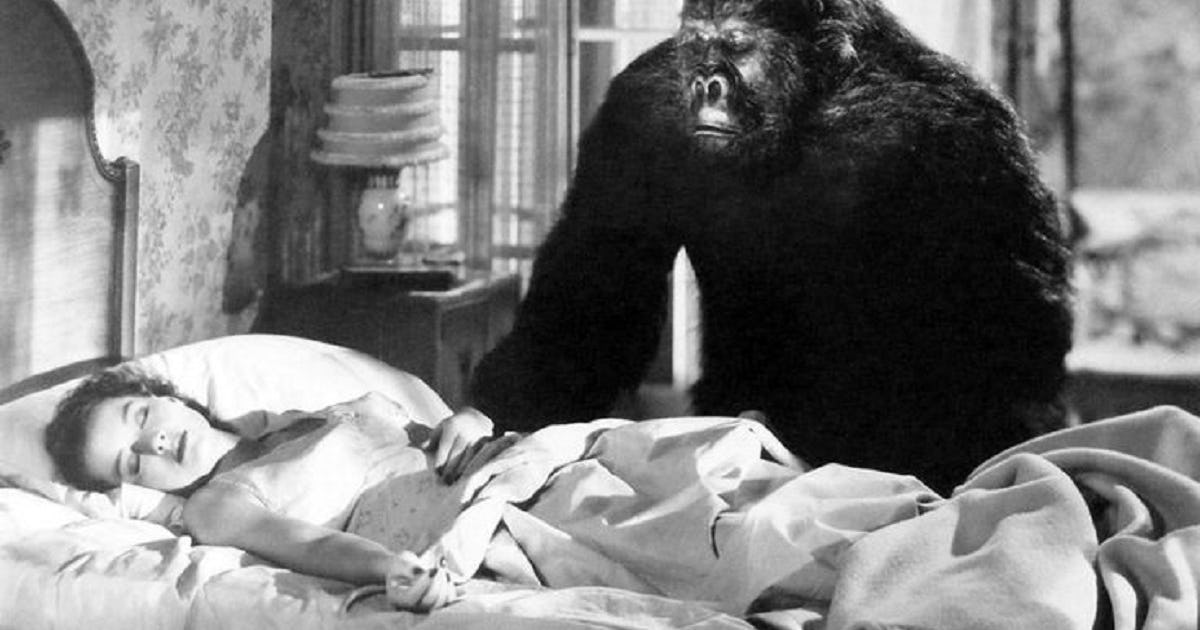
"Released 85 years ago today, the black-and-white curio was also the only such film to give as much attention to the courtroom as the laboratory. As mild-mannered church organist Scot Webster (Philip Terry) finds himself accused of murdering a gang member, the first half largely plays out like a conventional legal thriller."
"The string of flashbacks that break up the trial confirm that he's an innocent man set up by head mobster W.S. Bruhl (Paul Lukas) to kill two birds with one stone. The victim was a former associate who needed to be taken care of, while having learned to his horror that his sister Susan (Ellen Drew) had been forced into prostitution by the big city gang."
"With 1941 still firmly in the Hays Code years, The Monster and the Girl had to tiptoe around Susan's predicament. And yet the film still fell foul of the censorship board, which objected to its themes of white slavery and its assumption that juries could be controlled by criminal forces."
Released 85 years ago, The Monster and the Girl stands as the only film to transplant a convict's brain into a gorilla while maintaining equal focus on courtroom proceedings and laboratory experimentation. Mild-mannered church organist Scot Webster is falsely accused of murder by mobster W.S. Bruhl, who orchestrated the crime to eliminate a rival and punish Scot for interfering with his exploitation of Scot's sister Susan into forced prostitution. The first half unfolds as a conventional legal thriller through trial flashbacks revealing Scot's innocence. Despite the Hays Code restrictions requiring euphemistic language around Susan's predicament, the film still faced censorship objections regarding white slavery themes and jury manipulation. Director Stuart Heisler develops the siblings' relationship through candid flashbacks, establishing their motivations and emotional stakes.
Read at Inverse
Unable to calculate read time
Collection
[
|
...
]