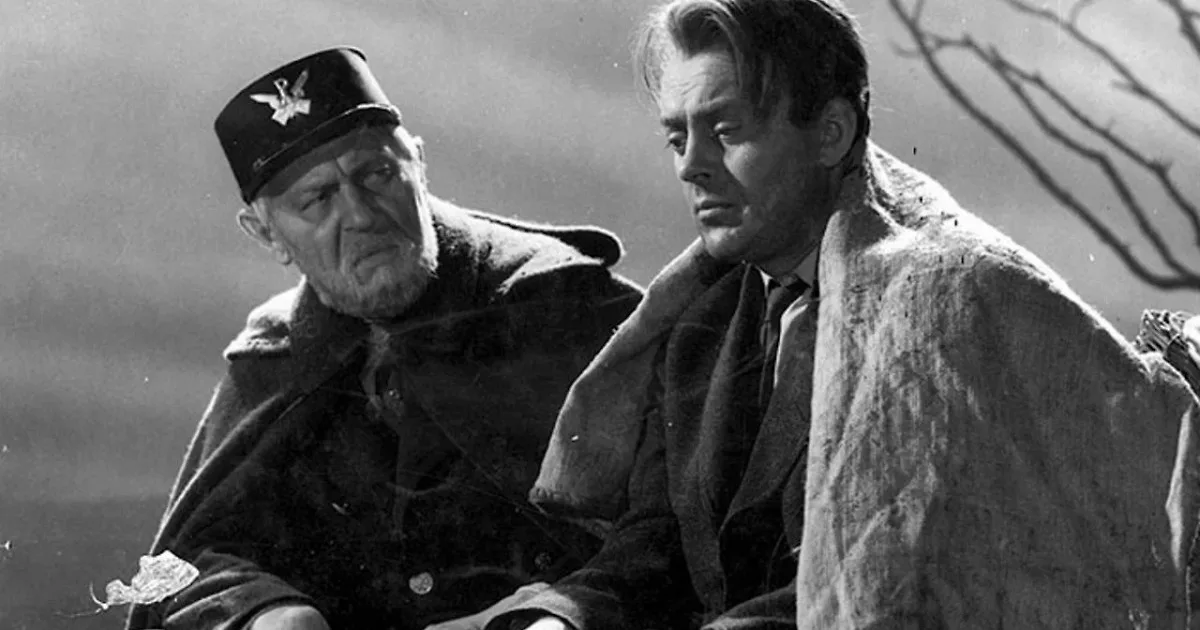
"Don’t underestimate the significance of Czech science-fiction - the word “robot” is a Czech invention, coined by author Karel Čapek for his 1920 play R.U.R. (Rossum's Universal Robots). Four years later, Čapek published the novel , a prescient cautionary tale about a scientist who creates a seismic explosive and realizes just how hellish its impact on mankind will be. A film adaptation was produced over 20 years later, when Czech director Otakar Vávra used the precarity of post-war Europe to influence his paranoid, hallucinogenic style - making Krakatit a genre hybrid that speaks to the subversive and disquieting arrival of the atomic age."
"Details of Krakatit’s original Czechoslovakian release in April 1948 are scarce, but there’s a lot to glean from its historical context. The film’s atomic anxieties would have been compounded by recent events - two months before the film’s release, the Communist Party of Czechoslovakia carried out a coup d’état on the government, bringing the country into the Soviet “sphere of influence” and worsening Cold War tensions. This meant the soon-to-be released Krakatit had to receive the new regime’s approval: a 1948 press report announced that “ Krakatit serves as an exceptional example of our nationalised film industry.”"
"In his essay about Czechoslovak sci-fi, Martin Šrajer puts Krakatit in conversation with “the trend of post-war skeptically-oriented” films in the genre, including The Day the Earth Stood Still, Godzilla, and Invasion of the Body Snatchers. But the noirish nuclear pessimism also makes Krakatit a precursor to Kiss Me Deadly, an American noir film from 1955 that later influenced David Lynch’s Lost Highway. Now available on 4K Blu-ray through Deaf Crocodile Films, Krakatit can be your sci-fi discovery of the year."
“Krakatit” connects Czech science-fiction history to postwar atomic anxiety, including the Czech origin of “robot” and a cautionary lineage from earlier speculative works. The film’s 1948 release occurred amid Cold War escalation after a Communist coup, requiring approval from the new regime and receiving official praise as an example of the nationalized film industry. Its paranoid, hallucinogenic style blends genre elements and reflects Europe’s precarity during the atomic age. Later comparisons place it alongside postwar skeptical science-fiction films and noir nuclear pessimism, with influence reaching American noir and later surrealist cinema. A 4K Blu-ray release makes it newly accessible.
#czech-science-fiction #atomic-age-cinema #cold-war-history #noir-and-nuclear-pessimism #otakar-vavra
Read at Inverse
Unable to calculate read time
Collection
[
|
...
]