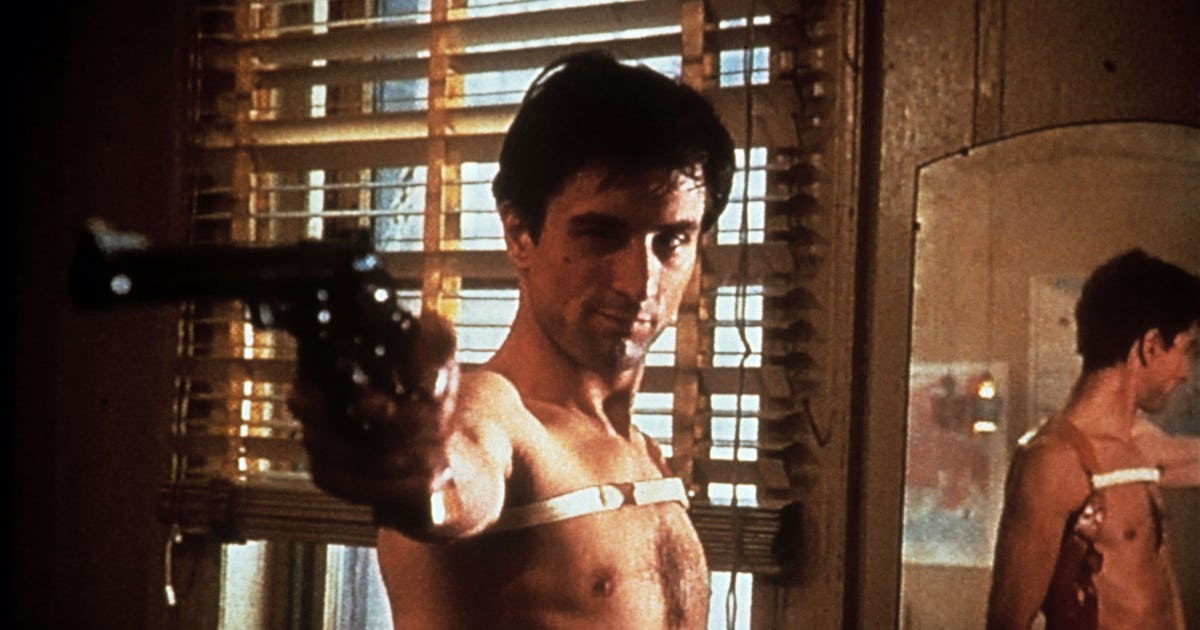
"The most haunting imagery in Taxi Driver - Martin Scorsese's classic psychological drama - tends to involve firearms, whether real or imagined. In intimate moments and public confrontations, former U.S. Marine Travis Bickle (Robert De Niro), now an insomniac cabbie, points real guns and L-shaped fingers at himself and others, perhaps most memorably, in a mirror. "You talkin' to me?" De Niro improvises, aiming straight down the lens, as the audience becomes both Bickle's victim and his violent reflection."
"After an honorable discharge, Bickle returns to the Big Apple to moonlight as a taxi driver, if only to deal with his unexplained insomnia. Gradually, we're introduced to his state of mind in the form of rambling voiceover, as we hear him slowly narrate his diary - a signature of screenwriter Paul Schrader - in which he writes jittery prose befitting a fourth grader, about how much he detests the city's moral rot."
Travis Bickle, an honorably discharged U.S. Marine, returns to New York and works as an insomniac taxi driver. He narrates a jittery diary voiceover expressing disgust at the city's moral rot. His fixation on Betsy and encounter with Iris, a trafficked teen, ignite a savior complex that leads him to prepare and point guns at perceived sinners. The film uses haunting firearm imagery, including the mirror scene and the improvised "You talkin' to me?" moment, to collapse private fantasy and public menace. The film influenced on-screen vigilante archetypes and endured as a cultural touchstone.
Read at Inverse
Unable to calculate read time
Collection
[
|
...
]