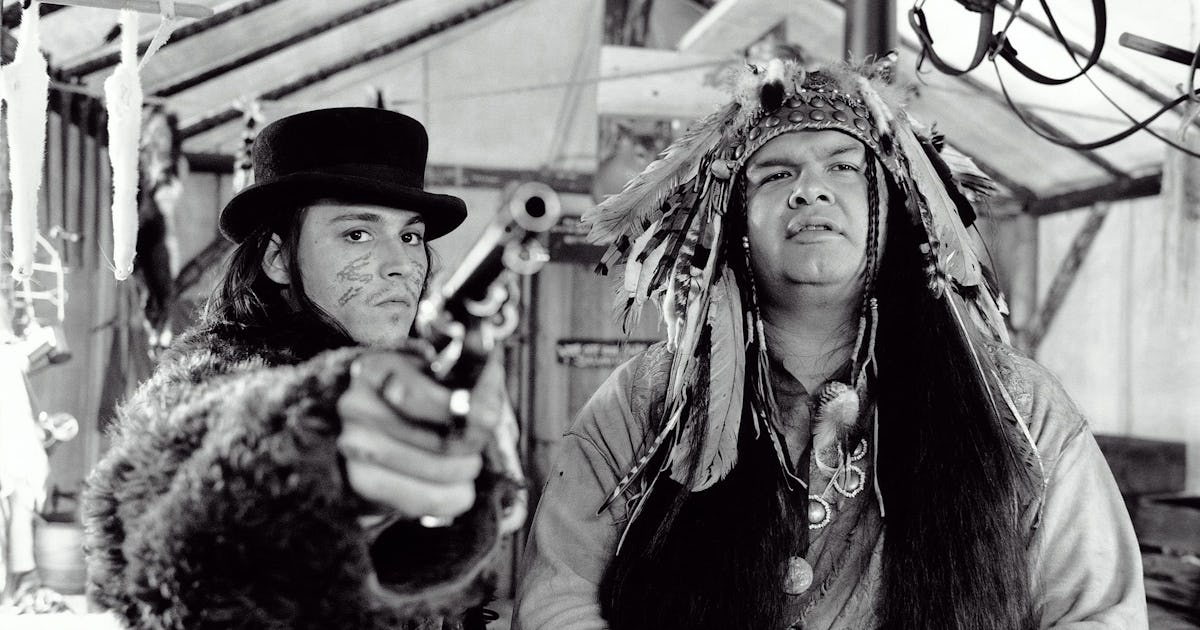
By the mid-1990s, Westerns returned to prominence when Kevin Costner's Dances With Wolves and Clint Eastwood's Unforgiven won Best Picture, reversing decades of dormancy after Heaven's Gate. Both followed 1985 films (Silverado, Pale Rider) that primed their stars. Both films confronted the racist and violent legacy of Western heroism, helping spawn a '90s boom in revisionist Westerns alongside American independent cinema. Jim Jarmusch's Dead Man exemplifies this intersection, portraying accountant William Blake (Johnny Depp) as a wounded traveler guided by an outcast Native American (Gary Farmer) who views him as the reincarnated poet William Blake. Dead Man initially underperformed and received mixed reviews, but later gained acclaim for its subversive humor, Neil Young score, cameo performances, drifting narrative, and poetic, hallucinogenic style.
"By the middle of the 1990s, two Westerns had won Best Picture in three years. That was a big deal, because the genre had been more or less dormant since Heaven's Gate cratered at the box office in 1980. The successes of Kevin Costner's Dances With Wolves and Clint Eastwood's Unforgiven came a few years after Costner starred in Silverado and Eastwood tested the waters by directing and starring in Pale Rider, two 1985 films that set the stage for the leading men to dazzle audiences and Academy voters with much grander follow-ups."
"Both also tried to address the racist and violent legacy of heroism in Western films, remaking the genre for a new, sophisticated era of Hollywood filmmaking. The '90s uptick in revisionist Westerns developed alongside the growth of American independent cinema, and the intersection of these two booms is Jim Jarmusch's Dead Man, now available in 4K thanks to the Criterion Collection. In it, accountant William Blake (Johnny Depp) survives a gunshot and is guided through the haunted American frontier by an outcast Native American (Gary Farmer) who believes that his charge is the reincarnation of the William Blake, the classic Romantic-era English poet."
"Like many of Jarmusch's films, Dead Man did not draw universal acclaim. It was Jarmusch's sixth feature, but the period setting significantly jacked up the budget compared to his cheaper dramas. In an undeserving pan, Roger Ebert criticised many elements, like Neil Young's hypnotic, throbbing guitar score and Jarmusch's desire to not satisfy our expectations, that make it so compelling. Dead Man grossed only $1 million upon release, but it's since earned a reputation as one of the best films of the '90s."
Read at Inverse
Unable to calculate read time
Collection
[
|
...
]