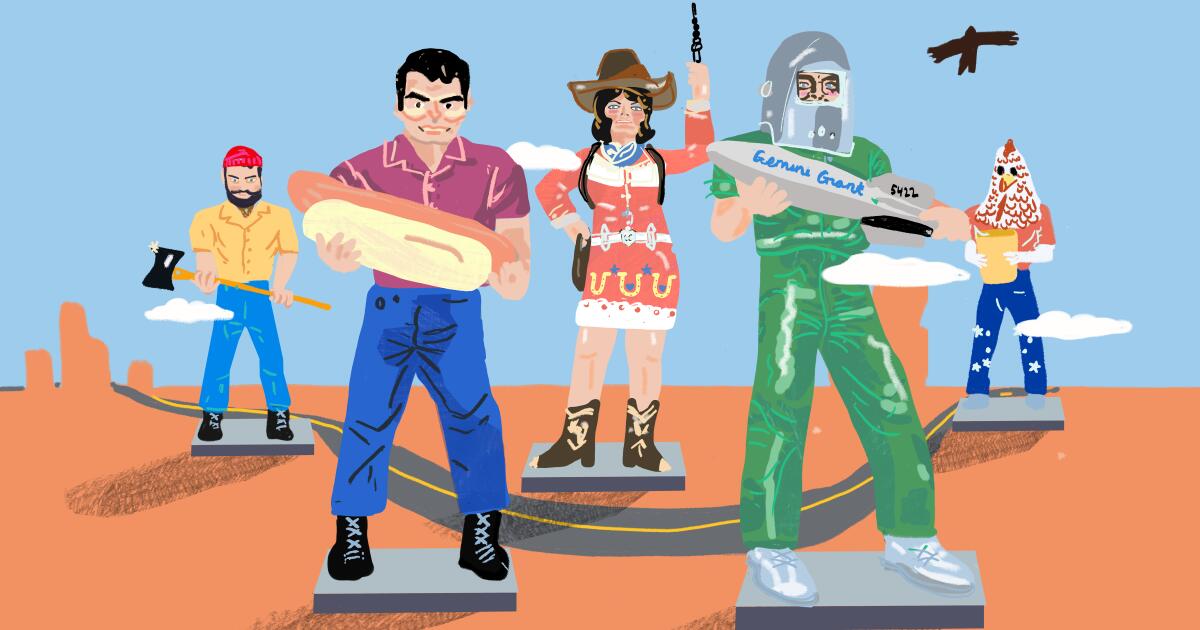
"Easter Island has its stone-faced monoliths. China has its terra-cotta warriors. And we Americans have these roadside giants, also known as Paul Bunyans, Uniroyal Gals and most commonly, Muffler Men. Manufactured in Los Angeles, they first appeared on the highways of North America in the early 1960s as an advertising gimmick, often promoting car lots or car parts. Now they're rising again, a battalion of restored and replica specimens, beloved by road-trippers, kitsch aficionados, artists, preservationists and savvy entrepreneurs."
""To me, they're kind of instant friends," said Amy Inouye, the designer and artist who rescued L.A.'s most iconic Muffler Man, Chicken Boy, a chicken-headed statue that stands atop her gallery in Highland Park. "They're really tall and they just want to be accepted for who they are.""
"Nobody's certain how many figures were made during the golden age of Muffler Men, but since 2020, the tally of giants has climbed above 250, including "a few dozen" rediscoveries since 2010, according to Doug Kirby, the co-founder and publisher of the site. "Just in the last year or two, all these Muffler Men are being added," he said. In addition, more than a dozen giants are currently in transition - that is, getting reconditioned or relocated."
A fiberglass roadside giant known as a Muffler Man stands tall with an ax and a grin, serving as an iconic American roadside figure. Muffler Men first appeared in the early 1960s in North America as advertising gimmicks, often promoting car lots or car parts. They are also known by other names such as Paul Bunyans and Uniroyal Gals. Many figures have been rediscovered, restored, and replicated, with renewed interest tied to Route 66’s 100th anniversary. A tracking effort maps these giants, and counts have risen above 250 since 2020. Designers, artists, preservationists, and entrepreneurs work to rescue, recondition, and relocate the statues so they can be accepted and appreciated.
#roadside-americana #route-66 #kitsch-and-collectibles #public-art-preservation #automotive-advertising
Read at Los Angeles Times
Unable to calculate read time
Collection
[
|
...
]