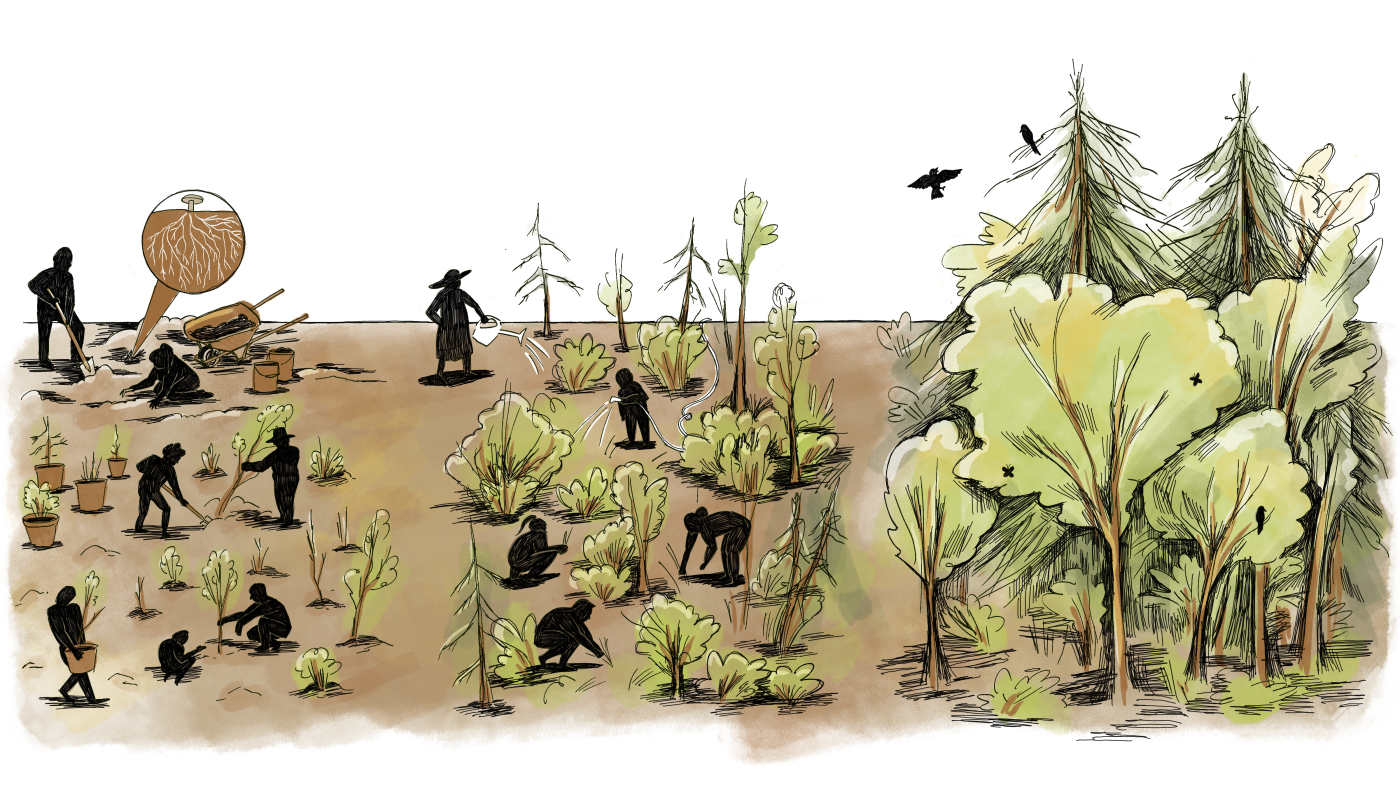
Communities are moving forward on climate solutions despite political headwinds and federal delays. States, cities, regions, and neighborhoods are cutting climate pollution and adapting to extreme weather. In Tacoma, Wendy Clapp fought Japanese knotweed for 25 years and used the Miyawaki method to restore her yard as a dense pocket forest. The method plants native trees and vegetation close together so plants compete for nutrients and sunlight, producing rapid growth and a mature forest within 20 to 30 years. Similar pocket forests exist worldwide, including a small forest planted by the Yakama Nation at a corrections and rehabilitation facility. The project is framed as creating opportunities through restored habitat and shade.
"NPR is dedicating a week to stories and conversations about how communities are moving forward on climate solutions despite significant political headwinds. As the federal government halts plans to address climate change, states, cities, regions and even neighborhoods are trying to fill the gap by cutting climate pollution and adapting to extreme weather."
"Clapp turned to a decades-old planting method from Japan to design her forest. The Miyawaki method involves planting native trees and vegetation close together so densely that 350 trees can fit in an area as small as six parking spaces. The plants compete for nutrients and sunlight, forcing them to grow quickly. Within 20 to 30 years, a fully mature pocket forest emerges."
"Clapp's forest begins through a wooden gate. Wild strawberries, ferns and Pacific ninebark cover the ground. A big leaf maple stands not far from Clapp's pride and joy, her paper birch. Clapp's burgeoning pocket-size forest is one of thousands found throughout the world, including India, Ireland, Brazil and the U.S."
"The Yakama Nation in Washington state planted a small forest at the Yakama Nation Corrections & Rehabilitation Facility six years ago. "We live in such a world right now, where we strive to learn about what [undisturbed land] looked like without knowing it," said Marylee Jones, a gatherer and member of the Yakama Nation. "When you do things like this, you're setting up opportunities.""
#climate-solutions #local-environmental-action #pocket-forests #native-planting #extreme-weather-adaptation
Read at www.npr.org
Unable to calculate read time
Collection
[
|
...
]