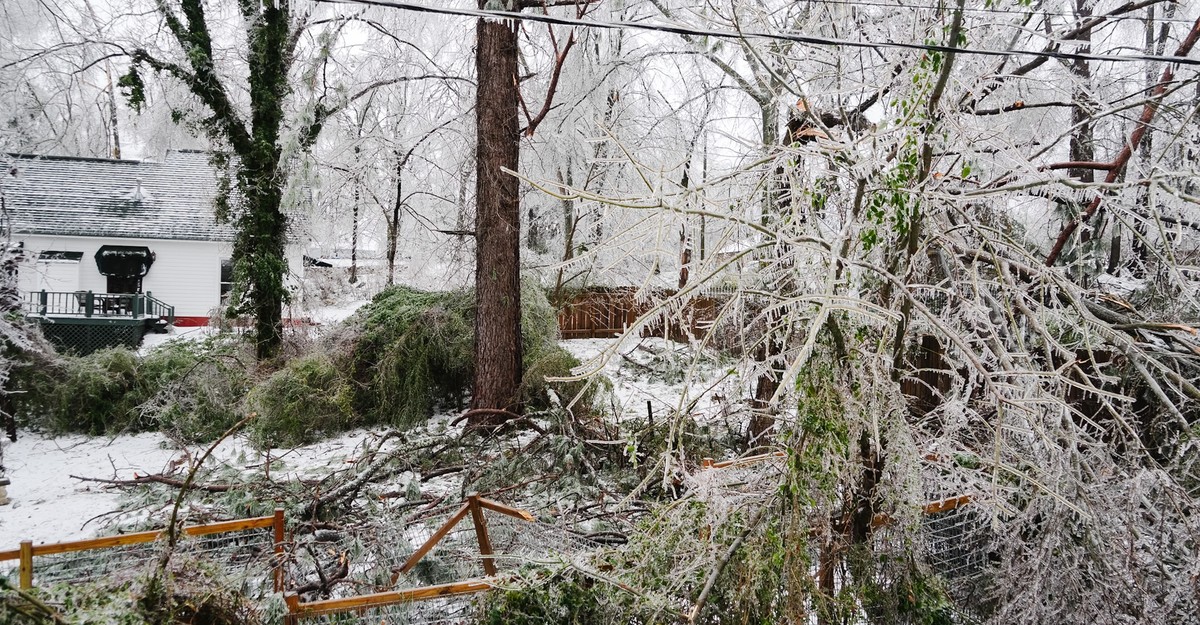
"On the Saturday night that the storm hit Mississippi, we had dripped our faucets for the temperature drop and stockpiled flashlights, groceries, extra blankets. By 11:30 p.m., my husband was pulling on his rain boots and heading outside to tarp our heating unit: "A branch has already fallen onto a power line in our backyard," he told me. Three hours later, I was shaken awake. "Mom, I think a tree just fell on our house," my 13-year-old son said."
"For the next six or so hours, every few minutes, we heard tree branches cracking, encased in ice and barreling to the ground like meteorites, exploding on contact with the earth. At each crack, we thought, Will this be the one that hits our house? Or our neighbors'? Will we lose our giant oak tree? Under the weight of five blankets and three sleeping bags, we waited for the storm to pass, for daylight to break,"
"As a young child, often surrounded by oaks, pines, sycamores, cedars, and more, I found comfort and beauty in the trees. Many of the old trees in Mississippi have been preserved simply because no one had reason to cut them down. So much of the state is undeveloped, and that has allowed nature to be still and simply continue to live."
A severe ice storm struck a small Mississippi town overnight, prompting preemptive measures like dripping faucets and stockpiling supplies. Falling branches and downed power lines began before midnight, and several hours later a large branch struck near the house. For hours branches encased in ice cracked and crashed to the ground, creating anxiety about potential roof and tree losses. The town sits among enduring oaks, pines, sycamores and cedars, many left intact due to limited development. Childhood experiences included building forts in nearby woods and finding comfort in trees. The storm threatened both the physical safety of homes and the preservation of longtime trees.
Read at The Atlantic
Unable to calculate read time
Collection
[
|
...
]