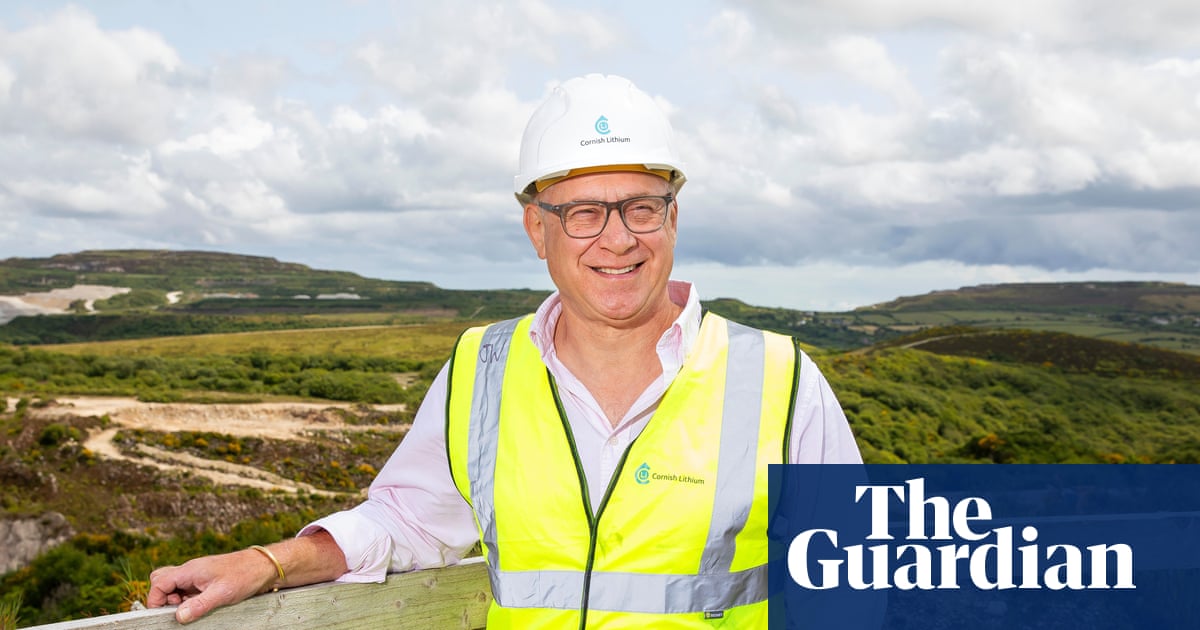
"It looks more like the past than the future. A vast chasm scooped out of a scarred landscape, this is a Cornwall the summer holidaymakers don't see: a former china clay pit near St Austell called Trelavour. I'm standing at the edge of the pit looking down with the man who says his plans for it will help the UK's transition to renewable energy and bring back year-round jobs and prosperity to a part of the country that badly needs both."
"But first to the past, when this story begins, about 275-280m years ago. There was a continental collision at the time, Frances Wall, professor of applied mineralogy at the Camborne School of Mines at the University of Exeter, explained to me before my visit. This collision caused the bottom of the Earth's crust to melt, with the molten material rising higher in the crust and forming granite."
A former china clay pit near St Austell called Trelavour is proposed for redevelopment to support the UK's transition to renewable energy and restore year-round jobs and local prosperity. Geological processes about 275–280 million years ago formed granite in Cornwall whose mica minerals can contain lithium. Victorian miners noted lithium in groundwater historically. Political attention and commercial interest have focused on extracting Cornish hard-rock lithium at former mine sites. Project supporters emphasize regional economic benefits and the role of local lithium supply in energy transition, while noting potential private profit alongside community objectives.
Read at www.theguardian.com
Unable to calculate read time
Collection
[
|
...
]