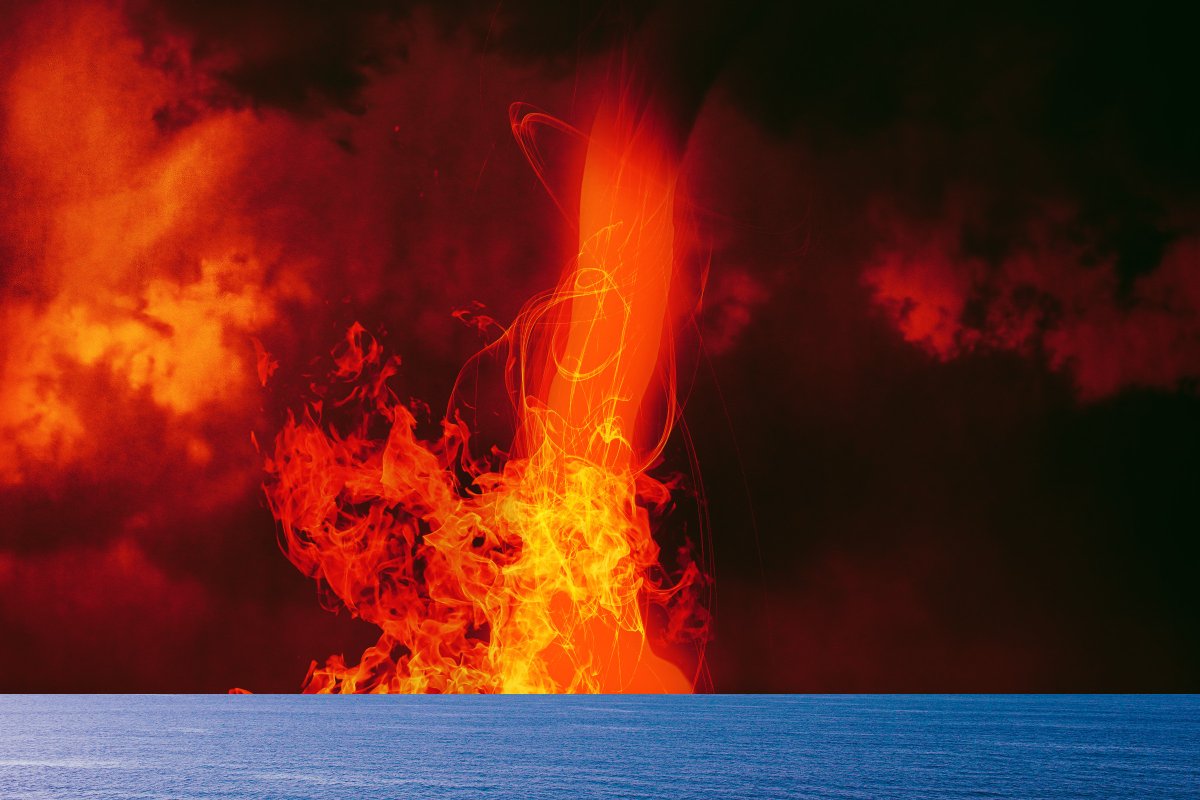
"The theory is pretty simple: fire whirls, spinning rapidly upward instead of outward, provide a massive boost to oil burn-offs, creating a fire that burns much hotter - and therefore much faster - than typical oil pool burn-offs. (Remarkably, the current world-standard for cleaning an oil spill is to gather a huge pool of crude on the surface and light it, a technique known as in-situ burning.)"
"To carry out the experiment, researchers built three 16-foot walls, situated in a loose triangle. The result was a controlled fire-tornado reaching 17-feet in height at its largest, which the scientists probed for environmental impact. Compared to in-situ burn-offs, researchers at Texas A&M found the controlled fire whirl produced 40 percent less soot, while burning off up to 95 percent of the fuel."
Texas A&M researchers tested controlled fire whirls as a method to remediate oil spills. Fire whirls spin rapidly upward, producing hotter and faster combustion than typical oil pool fires. The team constructed three 16-foot walls arranged in a loose triangle to generate a controlled fire tornado reaching 17 feet. Experimental results showed up to 95 percent of fuel burned and approximately 40 percent less soot compared with standard in-situ burn-offs. The technique accelerates oil removal and lowers particulate emissions, but requires further assessment of environmental impacts and operational feasibility.
Read at Futurism
Unable to calculate read time
Collection
[
|
...
]