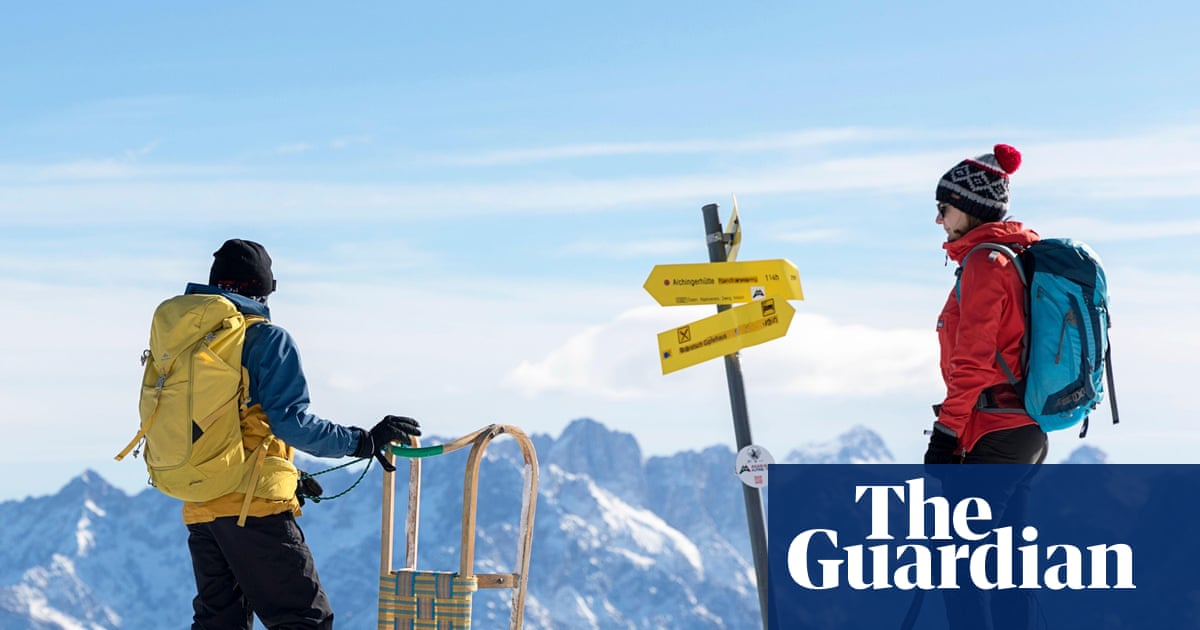
"Walking up a winding trail in the Dobratsch nature park in Carinthia, surrounded by picturesque snowy slopes dotted with pines, we hear shrieks coming from round the corner. The path is as wide as a one-way street but Birgit Pichorner, the park ranger I'm taking a tour with, motions for me to move to the side, where we watch a couple with wide grins glide past on a wooden toboggan."
"We have seen families out hiking with young children and speed walkers pacing for the summit, while on a trail above us, four skiers are zigzagging up one of the nature park's designated ski touring routes. For residents of Villach, the southern Austrian town at the foot of Dobratsch, this is very much their Hausberg, a much-loved locals' mountain, says Birgit."
"Until 2002, it was a ski resort Birgit points out the slopes where she learned and later taught her kids to ski but after successive bad winters at the turn of the century, the town faced the same choice as many ski resorts across the Alps today, as the climate crisis brings higher temperatures and reduced snowfall. Bring in the snow guns and supplement your natural snow offering with the fake stuff? Or chart a different path?"
"The environmental cost of artificial snow is high it's energy- and water-intensive The environmental cost of Maschinenschnee, as the Austrians call artificial snow, is high it's energy- and water-intensive, with many resorts pumping water up from the valleys to service their slopes. It also negatively affects these fragile ecosystems by introducing potentially pathogenic and stress-tolerant bacteria to the snow, meltwater and soils, according to the hydrologist Prof Carmen de Jong."
Dobratsch offers diverse winter recreation including tobogganing, hiking and ski touring and serves as the beloved Hausberg for Villach residents. The mountain operated as a ski resort until 2002, when successive bad winters prompted a choice between investing in artificial snow or pursuing alternatives. Artificial snow demands high energy and water inputs and can introduce pathogenic, stress-tolerant bacteria into snow, meltwater and soils. Residents feared contamination of karst-fed drinking water and therefore prioritized environmental and public-health concerns, closing the resort and developing a community-focused nature park instead.
#dobratsch-nature-park #artificial-snow-maschinenschnee #climate-change-and-skiing #water-quality--karst-systems
Read at www.theguardian.com
Unable to calculate read time
Collection
[
|
...
]