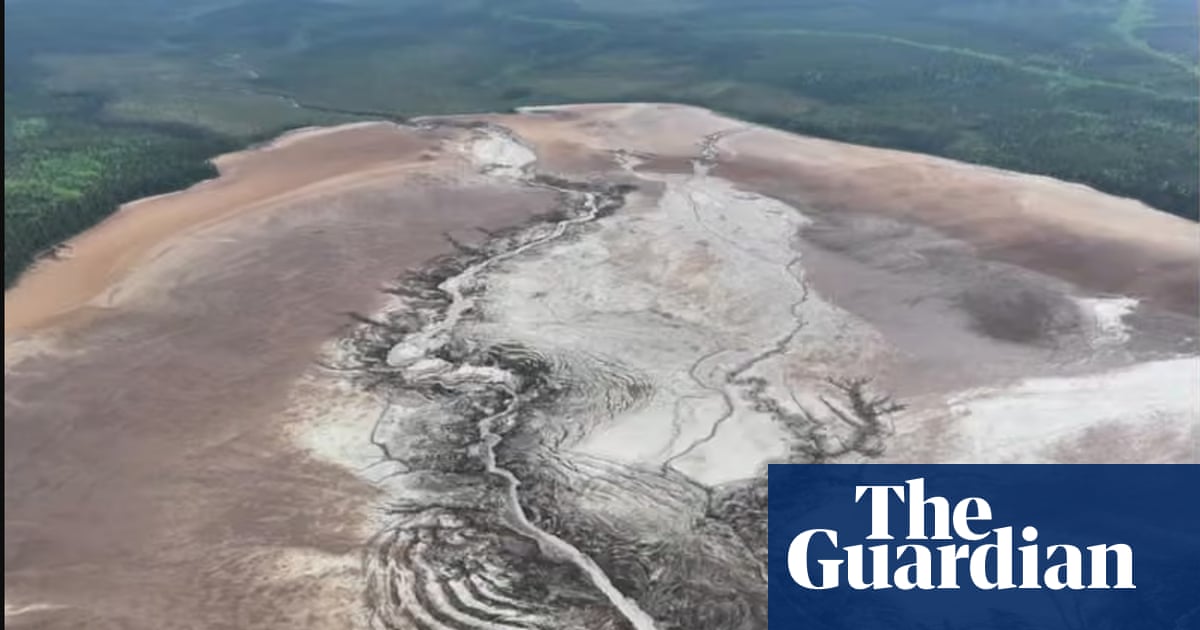
"Lake Rouge was a calm lake nearby with trout, sandy banks and a surface area of about 3 sq km. By gone, they weren't sure what the man was getting at. Dixon and his parents got their first glimpse as they walked up a logging road the next day. All the water of Lake Rouge had, in fact, vanished. Eagles and crows soon began to circle over the mud and dead fish that remained."
"He said his father was quiet when he first saw it, but then started narrating a rush of memories the lake's really clear water, and how moose gravitated there. A massive mud plain cutting north-east made it clear where the water had gone. It had travelled almost 10km overland into a bigger lake. Amazingly, no one had been hurt in this gigantic was it a mudslide? A flood? Nobody was sure what to call it."
"There is a name for this kind of sudden drainage of a lake an outburst flood but in recorded history these have usually happened at glacial lakes, when the underlying ice cracks, or at manmade reservoirs when the dam fails. Half a dozen international experts in the field told the Guardian they had never heard before of an outburst flood from a natural, non-glacial lake."
Lake Rouge, a roughly 3 sq km lake near Waswanipi, northern Quebec, suddenly emptied when water carved a new outflow and flowed almost ten kilometers into a larger lake. The drained basin exposed mudflats, dead fish, and attracted circling eagles and crows. Local residents observed the devastation and recounted memories of clear water and wildlife. The community chief convened an emergency meeting because people did not know how to respond. Experts classified the event as an outburst flood but noted that such floods are normally tied to glacial lakes or failing reservoirs, making this case unprecedented for a natural non-glacial lake.
Read at www.theguardian.com
Unable to calculate read time
Collection
[
|
...
]