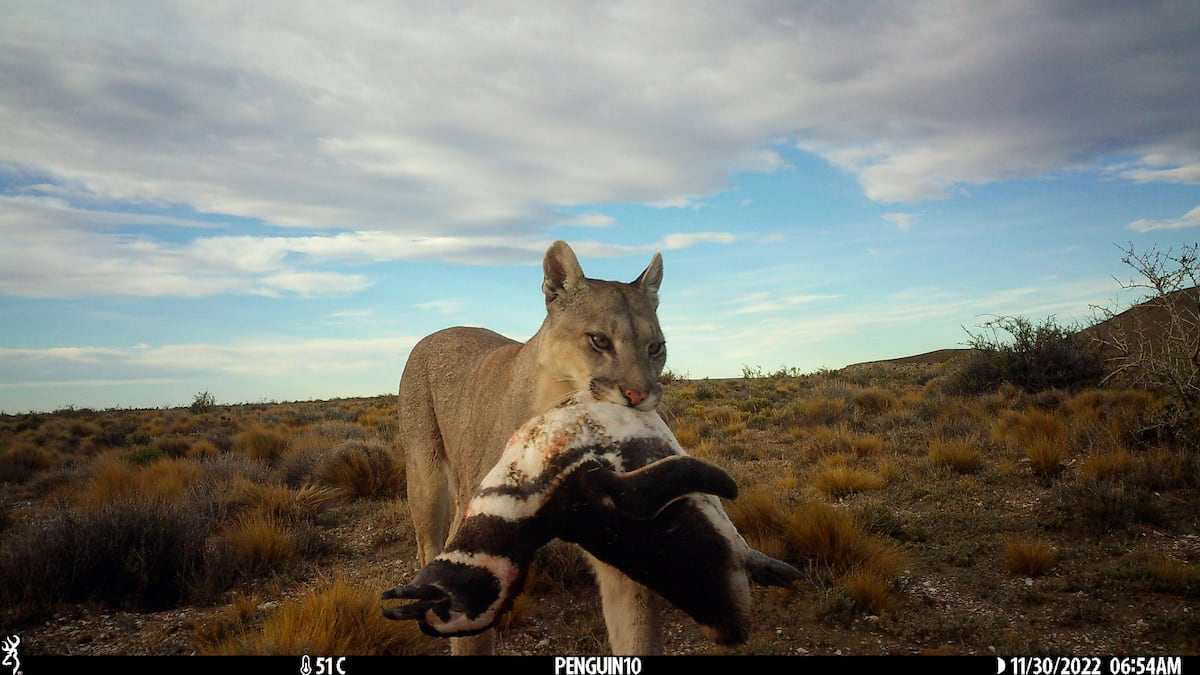
"The big cats have encountered a transformed ecosystem, whose large numbers of penguins is altering their behavior, leading to unprecedented local population density for the species. An international team of scientists has documented this finding in Monte Leon National Park, in southern Argentina's Santa Cruz province. According to ecologist Mitchell Serota from the University of California, Berkeley, who led the study, it makes the effects of conservation in transformed ecosystems clear."
"Magellanic penguins form enormous colonies and spend more than half the year on land. They are abundant, easily spotted, and have no way of defending themselves against a large feline. In contrast to other prey, these birds have not adapted to predators on land. This is the combination of two key factors for the pumas: there are so many penguins, and they are easy to catch, sums up Serota."
Pumas were extirpated from Argentinian Patagonia during the 20th century to make way for sheep farming, allowing Magellanic penguin colonies to expand from offshore islands onto the continent. Pumas have since returned after fauna restoration efforts and now face an ecosystem transformed by abundant penguins. Magellanic penguins form enormous, easily visible colonies, spend more than half the year on land, and lack defenses against large terrestrial predators. Pumas exploit this prey by reducing their roaming, concentrating activities around colonies, lingering in coastal areas, and repeatedly returning, producing unusually high local puma densities and increased social interactions.
Read at english.elpais.com
Unable to calculate read time
Collection
[
|
...
]