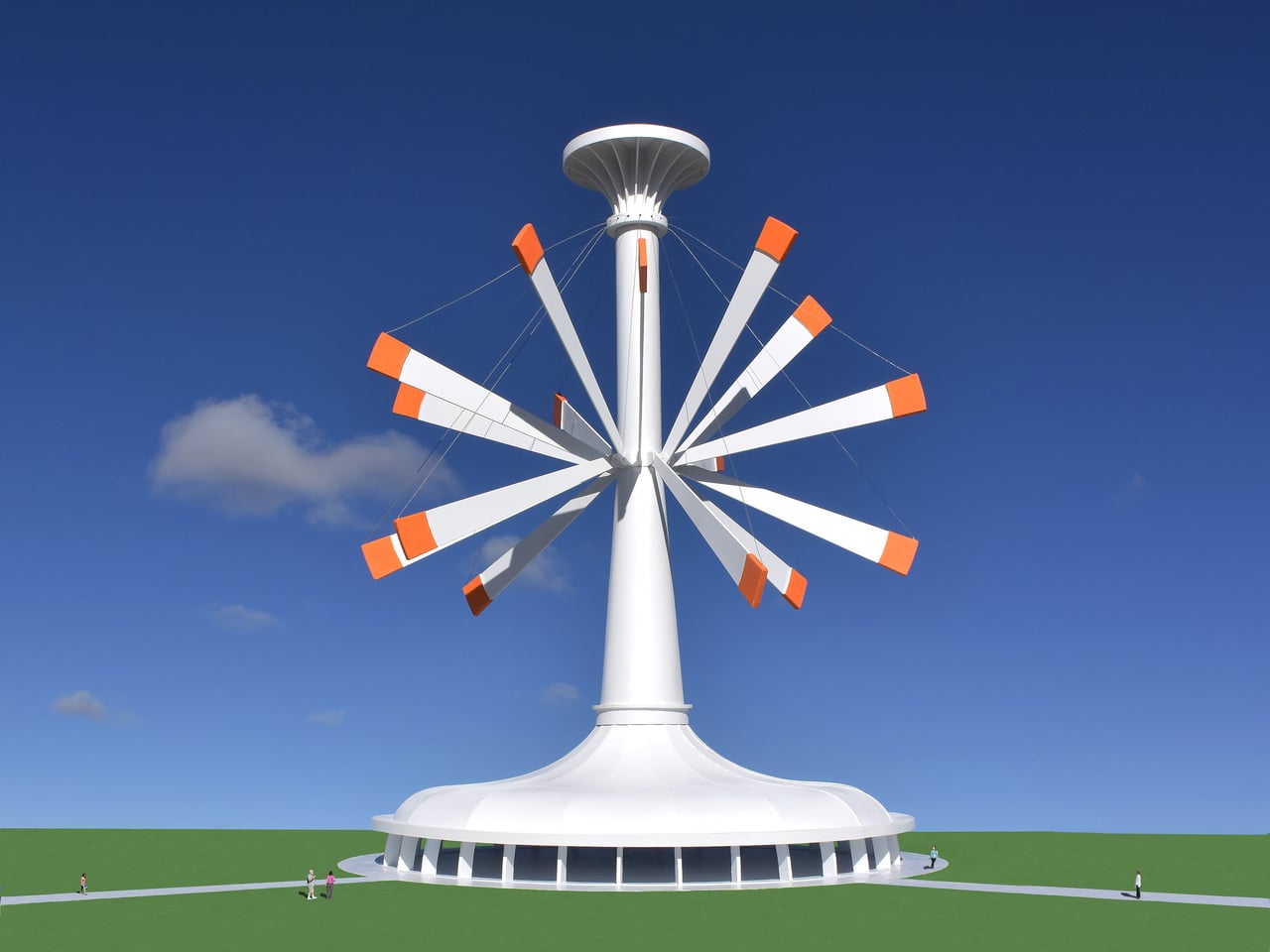
"Most renewable energy systems hide in plain sight. Rooftop solar panels blend into shingles, batteries sit in containers behind fences, and wind turbines spin in distant fields. They quietly do their jobs without helping anyone understand what happens inside them, which feels like a missed opportunity when you are trying to build support for systems that might keep the planet livable for another generation or two."
"The cycle works simply enough. A solar cell array at the top powers 16 winches that pull the weighted arms upward, storing potential energy. When the pavilion needs electricity, or when someone wants to change its shape, the arms fall back down under gravity. Their descent drives 16 generators that feed power to the building or local grid, turning stored height into usable electricity without batteries or other complex systems getting in the way."
"Arriving on a sunny afternoon, you would see the arms at different angles around the tower, sometimes clustered vertically, sometimes fanned out like a mechanical flower. The shifting positions are not just decorative but are the visible result of energy being stored and released. You can read the building's energy state in its skyline without needing a diagram, which turns out to be a surprisingly rare thing for infrastructure to offer at any scale."
The pavilion combines an umbrella-shaped roof and a tall central tower with 16 long weighted steel arms that lift and lower throughout the day. A solar array at the top powers 16 winches that raise the arms, storing potential energy in their height. When electricity is needed or the shape is changed, the arms descend under gravity and drive 16 generators that supply power to the building or grid, eliminating batteries. The arms' positions provide a visible indicator of stored energy, and the sheltered interior floor hosts exhibitions, lectures, and performances with cables marking connection points.
Read at Yanko Design - Modern Industrial Design News
Unable to calculate read time
Collection
[
|
...
]