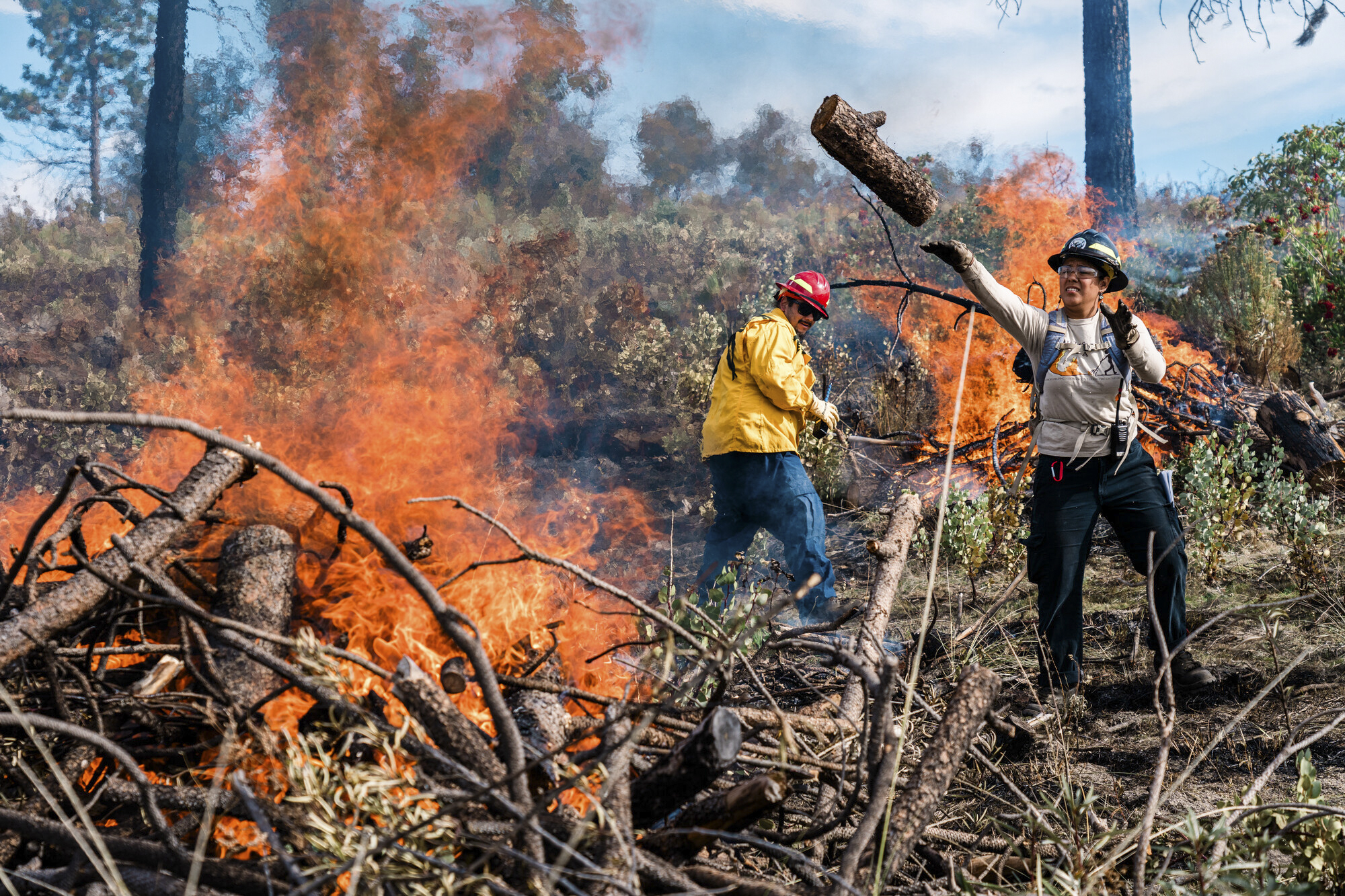
"Before burning the meadow, Herrera urged everyone to think about those who would gather materials in the coming months. "It's going to be a place where our people can gather food, fibers and medicines," she said. "We want to make sure all of that stuff stays really clean." Basket weavers often hold materials in their mouths, and it's long been a challenge to find plants free of fuel or herbicides. Here, the tribe can tend its garden as it chooses."
"Burners didn't use drip torches, which plop lit gasoline on the ground. Instead, in the months prior to the burn, Herrera trained a crew of Maidu women in traditional ecological knowledge - "my girls," she calls them. "My girls harvested a lot of sticks," she said, picking up one of the many bundles set aside for the burn. She held a lighter to the long twigs. "You light the stick, and the leaves start falling exactly like a drip torch.""
Fire in the Northern California region between Interstate 5 and the Sierra Nevada functions as both hazard and traditional land management tool for the Maidu. A formal training burn aimed to help the Berry Creek Maidu reestablish traditional fire relationships and to restore places for gathering food, fibers, and medicines. Tribal leaders emphasized keeping plant materials clean for basket weaving and other uses. Training prioritized traditional ecological techniques and manual ignition with burning sticks rather than drip torches. About 90 people attended and more than a dozen agencies and organizations partnered on the training. Other tribes, such as the Karuk and Yurok, have long-standing programs reclaiming intentional fire.
Read at Kqed
Unable to calculate read time
Collection
[
|
...
]