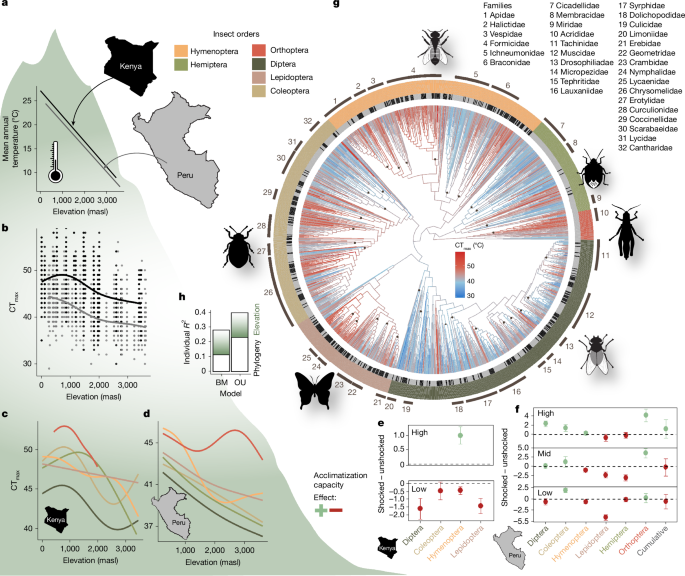
"More than 70% of all insect species are found in the tropics, where they are essential for ecosystem functioning. As small ectotherms, insects are particularly vulnerable to increasing temperatures, yet our knowledge of their heat response is limited. Despite their immense diversity, data on thermal tolerances of tropical insects are sparse and heavily biased towards a few groups."
"Currently, tropical lowland places are experiencing increasing average and extreme temperatures due to anthropogenic warming, underscoring the urgency of understanding the ability of insect communities to respond to increasing temperatures and to reveal upper boundaries of heat tolerance. Besides heat, cold waves also challenge tropical animal communities and are expected to increase in intensity under future climate scenarios."
"Heat tolerance is assumed to be strongly related to the ability of organisms to counter the destabilizing effects of high temperature on proteins. Although production of heat shock proteins can counteract destabilization from heat to some degree, upper thermal limits of protein stability are, in ectotherms, ultimate indicators of the threshold at which environmental temperature will have high costs and cause thermal injuries and mortality."
Insect diversity is declining globally as temperatures rise, with over 70% of insect species inhabiting tropical regions where they play critical ecosystem roles. Tropical insects, as small ectotherms, are particularly vulnerable to temperature increases, yet understanding of their heat response remains limited. Current data on thermal tolerances of tropical insects is sparse and biased toward specific groups like ants and fruit flies. Research suggests upper thermal limits show little plasticity along climate gradients, indicating insects may have low capacity to tolerate further warming. Tropical lowland regions now experience increasing average and extreme temperatures from anthropogenic warming, alongside intensifying cold waves. Heat tolerance relates to protein stability, with heat shock proteins providing limited counteraction against destabilization. Protein melting temperatures serve as ultimate indicators of thermal injury thresholds in ectotherms.
#tropical-insect-thermal-tolerance #climate-change-vulnerability #protein-stability-and-heat-stress #insect-biodiversity-decline #ectotherm-adaptation-limits
Read at Nature
Unable to calculate read time
Collection
[
|
...
]