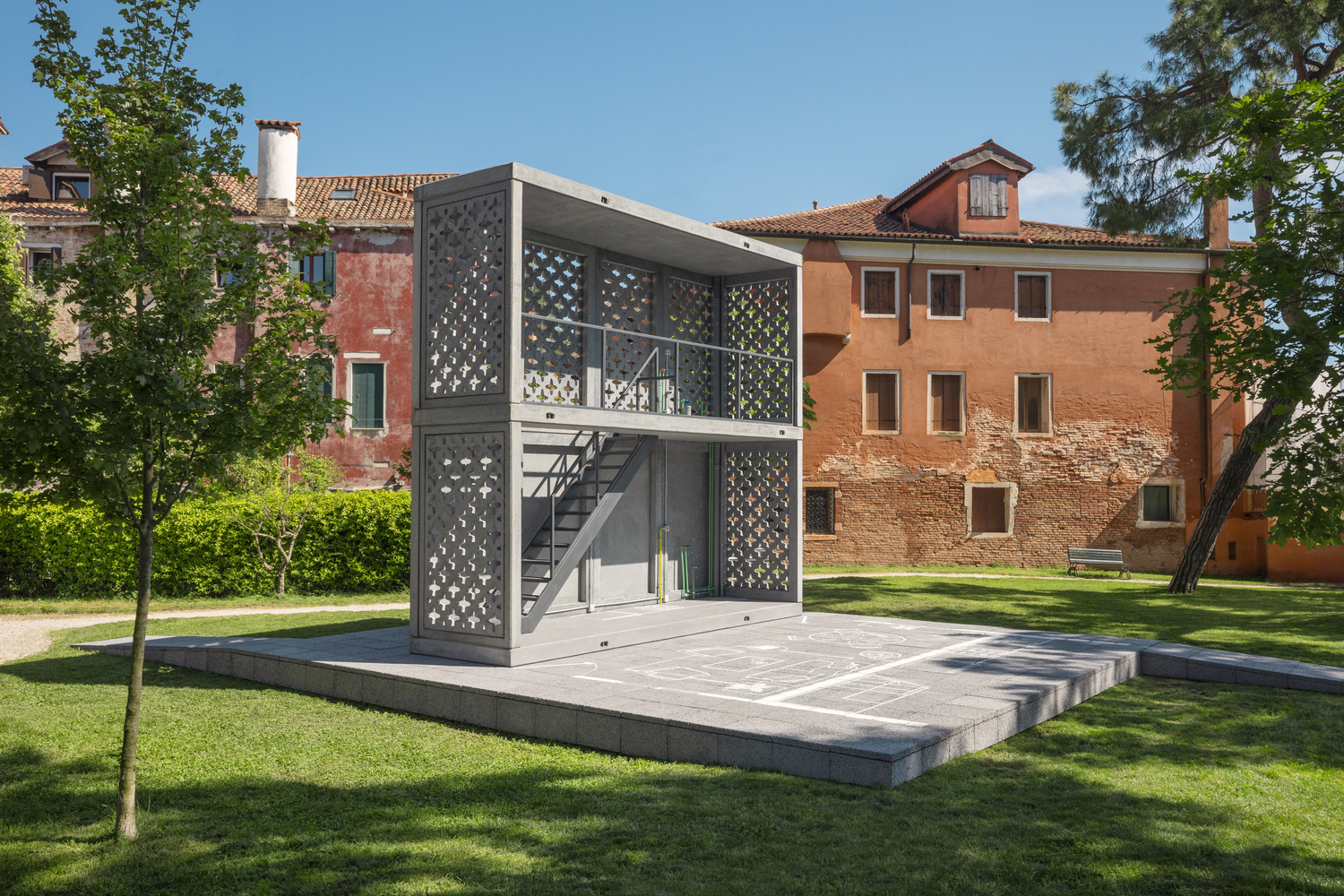
"During the Time Space Existence exhibition, organized by the European Cultural Centre in Venice, the building-solutions company Holcim and Pritzker Prize-winning architect Alejandro Aravena, with his firm ELEMENTAL, unveiled a full-scale prototype that introduces a new approach in incremental housing solutions. The housing prototype- The Basic Services Unit-was built with Hoclim's recently launched biochar technology, which transforms buildings into carbon sinks by permanently trapping carbon in a bio-based material called biochar."
"The biochar, we would hope, can make concrete an even more sustainable material for development on and around water. These materials can be used in a prototype project. It has the potential to proliferate on a larger scale very quickly. The idea that this new material engages with local waste to create a different type of concrete with net-zero carbon emissions is an incredible way to start-by engaging with local economies and local possibilities, with the specific problems and contexts of the world."
Holcim and architect Alejandro Aravena unveiled a full-scale Basic Services Unit prototype that applies biochar technology to incremental housing. The prototype incorporates biochar, a bio-based material that permanently traps carbon, as a component of low-carbon concrete, cement, and mortars, turning buildings into carbon sinks. Architects at the Biennale of Architecture 2025 noted biochar’s role in achieving net-zero alongside reuse of debris, its potential to make concrete more sustainable around water, and its capacity to be prototyped and scaled rapidly while engaging local waste streams and economies.
Read at ArchDaily
Unable to calculate read time
Collection
[
|
...
]