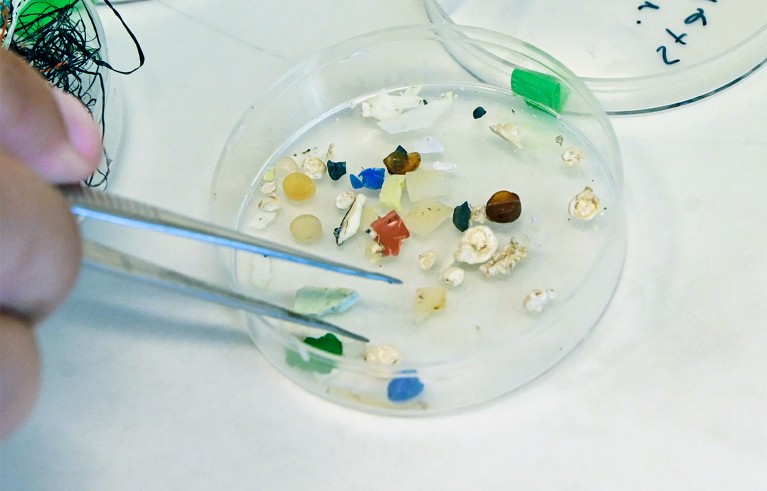
"The amount of microplastic particles in the atmosphere might be lower than some studies have suggested, possibly even by several orders of magnitude. The finding, published on 21 January in Nature, comes after a high-profile study, which was published in February, that suggested that the concentration of microplastics in the human brain might have been overestimated. "This doesn't mean we don't have a lot of microplastics in the atmosphere," says Ioanna Evangelou, an environmental scientist at the University of Vienna."
"Many human activities - from improper disposal of waste to the degradation of car tyres - release small plastic particles, which have infiltrated the atmosphere, oceans and other ecosystems. These include nanoplastics - particles measuring less than 1 micrometre across - and microplastics, which range from 1 micrometre to around 5 millimetres. They've entered our bodies and brains, and scientists are still working to understand their effects on people's health."
""We should not believe that this is not an issue," says Evangelou. She hopes that the main message of the results will not be used to dismiss the problem of atmospheric microplastics. Research on the biological effects of microplastics is still in its infancy, which means that it is not clear whether the levels humans are exposed to - whatever those levels are - are safe."
Atmospheric microplastic concentrations may be substantially lower than some previous estimates, potentially by orders of magnitude. Measurement methods vary widely across studies and lack global standardization. Small plastic particles originate from improper waste disposal, tyre degradation and other human activities, and include nanoplastics (under 1 micrometre) and microplastics (1 micrometre to about 5 millimetres). These particles have infiltrated the atmosphere, oceans, ecosystems and human bodies, including brains. Biological effects remain poorly understood because research is in its infancy, so current exposure levels cannot yet be judged safe. Researchers compiled existing studies to improve concentration estimates.
Read at Nature
Unable to calculate read time
Collection
[
|
...
]